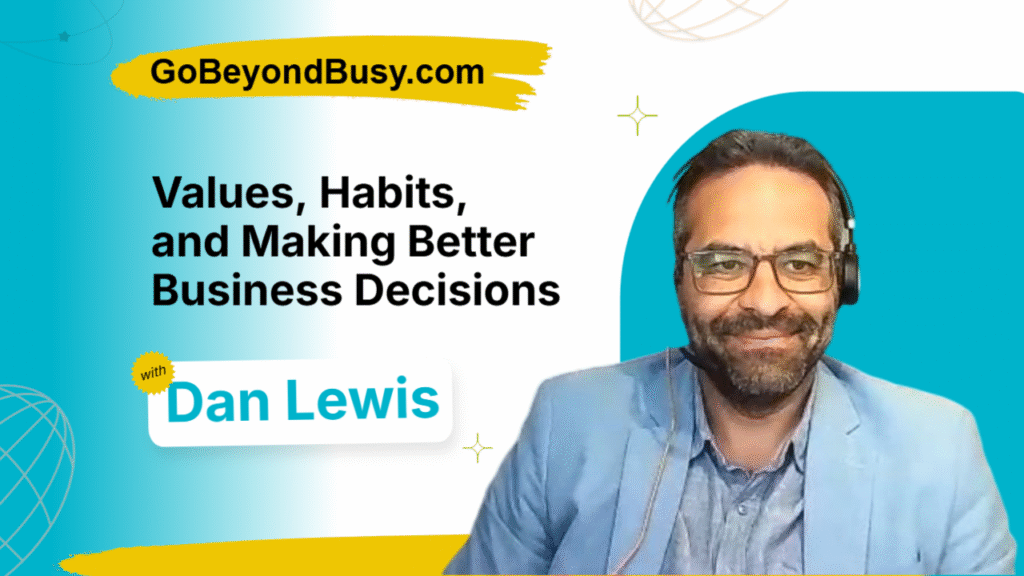
Most business owners do not struggle because they lack ideas or effort. Pressure usually builds when too many decisions are made at once, often without a clear filter for what truly matters. That was the starting point for this conversation with Dan Lewis from Financial Wellness Group on the Go Beyond Busy podcast.
Dan has spent years working with business owners and individuals who are capable, motivated, and hardworking, yet still feel stretched. His approach returns to three simple elements: values, habits, and relationships. He describes this as a triangle, with values holding the other two together.
Values as a decision filter
The role of values comes up early in the conversation. Dan explains that values are not the framed statements on a wall, but the everyday rules that shape what gets a yes and what gets a no. Business owners often say yes to too many opportunities, especially in the early stages, and that habit can quietly lead to burnout.
Clarity around values makes decisions easier. Time, energy, and attention shift toward work that actually fits, rather than work that simply looks attractive in the moment. Over time, that clarity reduces pressure because fewer decisions feel reactive.
Habits over goals
Goals receive plenty of attention in business, but Dan prefers to focus on habits and discipline. His experience, both personally and professionally, has shown that outcomes tend to follow consistent behaviour rather than constant goal setting.
Daily habits, such as focusing on one action that moves a sale forward, can make a meaningful difference, regardless of a business’s size or age. Progress becomes steadier when attention stays on repeatable actions instead of chasing the next big milestone.
For many business owners, this shift brings relief. Less energy is spent trying to do everything at once, and more focus is on doing the right few things consistently.
Being intentional with relationships
Relationships form the third part of the triangle, and this is often where uncomfortable realisations appear. Dan shares how reviewing where time is being spent can reveal mismatches between effort and return.
Some relationships receive a lot of time with very little benefit, while others deliver strong outcomes with minimal effort. Adjusting that balance can be difficult, but values provide the framework to make those choices with greater confidence.
In business, people sit behind most opportunities. Alignment around values and habits tends to produce stronger, more productive relationships over time.
Applying the triangle in financial advice
The same framework underpins how Financial Wellness Group works with clients. Dan describes a clear split between product-based advice, coaching, and education. Investments, insurance, and KiwiSaver matter, but the conversation usually starts somewhere else.
Client discussions focus first on people, lifestyle, and priorities. Numbers come later. This applies whether the client is a private individual or a business owner, with business treated as one asset among many rather than the centre of everything.
That perspective helps clients make financial decisions that support the life they want, rather than chasing numbers without context.
A calmer way forward
The message that runs through this episode is simple but powerful. Doing less with greater intention often yields better results than trying to do everything at once. Values provide direction, habits provide momentum, and relationships provide leverage.
For business owners feeling overwhelmed, this conversation offers a steady reset rather than another strategy to add to the list.
Dan can be contacted through https://fwg.nz
Want to read the transcript?
Introduction to the Episode
[00:00:00] Bernard: This episode of Go Beyond Busy features a conversation between business consultant Christine Abela and Dan Lewis from Financial Wellness Group in Christchurch, New Zealand.
[00:00:11] Dan shares a practical way of thinking about business through the lens of values, habits, and relationships, and explains how clarity in those areas can reduce pressure and improve decision-making.
[00:00:24] The discussion also covers Dan’s approach to financial advice, working with business owners as well as individuals, and supporting clients both in New Zealand and internationally.
[00:00:36] Hi, I am Christine from Go Beyond Busy. I’m here today with Dan Lewis from the Financial Wellness Group in Christchurch in New Zealand.
[00:00:43] How are you doing today, Dan?
[00:00:45] Dan Lewis: I am well, Christine. Thanks for having me on. How are you?
[00:00:48] Christine Abela: Very good. Tell me, what have you learned about running a business that you wish you’d known earlier?
Dan’s Business Philosophy: The Life Triangle
[00:00:55] Dan Lewis: I’ve pretty much learned the same thing that I’ve learned about life in general. It’s the same thing I’ve learned about parenting and I call it the life triangle.
[00:01:04] So it’s made up of three things. One is values. Two is habits or discipline. And three is relationships. So those are three components to my business.
[00:01:21] And from when I first started to now, what I’ve learned about those three things has changed quite a bit. Had I known what I know now or how I approach those three things, that would’ve been really useful at the start.
[00:01:37] So if you want me to go a little bit further into each of them, I can. Cool. So basically values underpins everything and it holds the other two together.
[00:01:49] So at Financial Wellness Group, that’s something that we pride ourselves on, that we take a values-based approach to clients. And so whether it’s me talking to my 14-year-old son who’s now becoming a man, or it’s dealing with clients, customers, or other businesses, what’s important is what is your value system.
[00:02:09] I’m not talking about that thing that you stick on the wall when you get a coach to come around. Like that can be good stuff, but like really, what are the day-to-day values that are driving everything you do? So basically, what do you say yes to and what do you say no to? To simplify it. And over time I’ve learned what to say no to more and more, as opposed to saying yes to every opportunity and burning out.
[00:02:37] Second. So the second two things are, discipline or habits. So books like Atomic Habits, James Clear, Seven Habits of Highly Effective People, Stephen Covey have been really influential. But I’ve moved away, and this is as a financial advisor as well, from looking purely at goals to looking more at habits.
[00:02:59] People talk about enjoying the journey and the process, and I think really what that means is putting good habits in place and the outcomes will happen, the goals will happen. So rather than working harder and once again putting too much effort in, it’s becoming really clear on the things that I should be doing and building those habits. I don’t quite have that. That’s something I’m working on all the time.
[00:03:28] And then the third part is relationships. And this is really tricky, but I’ve learned over time that you need to be really intentional with the connections you build and how you build them. You’ve got to decide who is in your really close sphere.
[00:03:47] Something that I realized last year when I went through a bit of an audit was I was spending quite a bit of time in some relationships with very little return. And other relationships, I was spending a little bit of time and actually getting a lot of return. And I needed to switch those things around, which was quite hard ’cause then it went back to my value system of saying yes and no and implementing that.
[00:04:10] So that’s how the triangle keeps working. And that’s the best thing I’ve learned in business and life.
Applying the Life Triangle in Business
[00:04:19] Christine Abela: So how could somebody who is, busy in their business and working really hard and struggling to find their way in business, how can they apply those principles to that business?
[00:04:34] Dan Lewis: I think I’d start once again with values and when you’re overwhelmed and you’ve got a lot going on, the worst thing to do is to do more or to go and read more. Actually you wanna do less.
[00:04:46] So my suggestion is just take some time out, get out of your business, get out of your head. Go away for a day or two if you can. Take a good old piece of paper and pen, and come up with 10 values. Jordan Peterson’s book I think it’s called 12 Rules of Life, was quite useful for this sort of thing. There’s tons of books out there.
[00:05:07] But if you can just really go back to basics and say, where am I? What is this business about? That would be a great starting point.
[00:05:15] And from there you can then start to slowly bit by bit. So the second part would be bit by bit, just take it one step at a time, incremental, because often as entrepreneurs, business owners, we have this tendency to just run more and more, lots of opportunities all over the place.
[00:05:33] Let’s just dial it back and go from there.
[00:05:38] Christine Abela: Once you’ve worked out your values, then you need to work on your habits or your discipline, and then you can work on your relationships. Is that how it works? Even in business?
[00:05:48] Dan Lewis: Yeah, I think so. Before we started Financial Wellness Group, which we launched, oh, what are we now going into our fourth year. So we were part of a bigger franchise group and at that stage, my brother and I, who I’m in partnership with, we’re managing around about two or 3000 clients.
[00:06:08] But we were chasing our tail the whole time. It was just maintenance.
[00:06:12] So by relaunching, we were able to get really clear on the type of values, the type of service and the way we want to deal with clients.
[00:06:21] So once we had that value system in place, it helped us figure out which systems we should use. And there’s a bit of trial and error there with things like CRMs and planning software and those sorts of things. But we are able to align that back to our value system. Yeah, does this align? Doesn’t it align?
[00:06:41] And we are then able to look at certain habits and disciplines. So for example, Stephen Covey speaks about keeping the main thing, something along those lines.
[00:06:51] And in business, one of the main things is sales. Like it doesn’t matter how good your systems, processes, and everything else are, you need to be making sales.
[00:06:59] So a really good simple habit is: what am I doing today to either make a sale, move the needle towards a sale. Irrespective the business is one day old with one client, or a thousand days with a thousand clients, is that’s just a core habit that needs to be put in place. And that’s now built on top of that value system.
[00:07:23] From there, you align with people. So probably the biggest opportunity any business will have is people. Whatever opportunity you are looking for in your business is going to involve a person more than likely. And so it becomes really important which people you interact with. Once again, you want those people to be aligned to your value system and even better if they have similar habits and disciplines.
[00:07:51] If they like the things that you like, that’s the basis of any relationship.
Financial Wellness Group: Services and Approach
[00:07:56] Christine Abela: Tell me a bit more about what Financial Wellness Group does and how do you apply these principles when dealing with your clients?
[00:08:05] Dan Lewis: So I’d probably split what we do into two main categories. On the one side, it’s very product-based. So yeah, we do investments like Kiwisaver, managed funds, share portfolios. We do insurance, mortgages. So your standard kind of financial advice products or what a financial advisor would do, New Zealand or globally really.
[00:08:32] And I think we do that stuff pretty well or better than average, hopefully. That’s largely skill-based and it’s just delivering a good service.
[00:08:44] On the other end, we do a lot of coaching and education, and this is the more exciting part. It’s what we’re more passionate about, and this is really where our value system comes into play.
[00:08:54] So rather than looking at the numbers first, we look at people first. I’ll often have clients come in, especially some of my engineering clients or business owners and they come in with a bunch of spreadsheets, and they’ve done a pretty good financial job already.
[00:09:10] But yeah, I’ll just move that aside.
[00:09:13] I don’t wanna talk about numbers, I wanna talk about you. I wanna figure out what’s meaningful, what’s the lifestyle you want to create. Because there’s a far bigger picture than just the numbers.
[00:09:23] We’ve got a coaching program, education programs around that, but just our approach to client meetings is to take a holistic look. And so in being values based, we are trying to figure out what is our client’s value system before we move on to the numbers.
[00:09:44] Christine Abela: So does that apply whether the client is a private person or a business? Does it make any difference?
[00:09:51] Dan Lewis: There’ll be slight differences in the way that we approach it. Or someone that owns a business, there’s gonna be two parts to it. There’s them as a private person. We see business as an investment. If we talking about property or bonds or managed portfolios or gold or even crypto, I see business as one of those investment asset classes.
[00:10:15] So in some ways it’s no different because we are more concerned about you the person than your business. Your business is an investment tool or resource just like all your other assets.
Global Reach and Future Plans
[00:10:29] Christine Abela: You are based in Christchurch in New Zealand, but can you work with people outside New Zealand?
[00:10:35] Dan Lewis: Yes, and we do quite a bit. So we do this in two ways. One is pretty established, the other one is actually quite new and something that I’m working on and will launch properly early next year (2026).
[00:10:46] The established part we do it quite a bit is when we move assets like pensions. So we deal with a lot of clients that have immigrated to New Zealand. So they might be from the UK or South Africa or Australia. They are needing to move their superannuation funds to New Zealand or vice versa, where they’ve now moved from New Zealand to other countries. We deal with a lot of clients on that basis and that can be quite specialized. Can be, it is quite specialized, so there’s not too many people that deal with that aspect.
[00:11:17] The second aspect is more on the coaching side of things. So I’m launching a community which is gonna be education based rather than financial advice based. We are planning to launch this in early 2026.
[00:11:32] And this will be a bit broader in its scope. So we’re gonna talk about things like cryptocurrency, which at the moment we don’t have clear rulings on from the FMA, what is and what isn’t financial advice. And it’s obviously a whole new area.
[00:11:46] So I’ve partnered with someone in Australia. And we are working together with clients strategically to help them build out a crypto portfolio. And that’s because there are a lot of issues with crypto, obviously. There’s security issues, there’s trust issues, there’s a whole bunch of things.
[00:12:05] So I’ve done a lot of due diligence around those things with the guy that I’m partnering with. And then we’ll offer the service, which will be New Zealand, Australia, and obviously global.
Advice for Potential Clients
[00:12:18] Christine Abela: If someone is thinking about going to a financial advisor, what’s a good place to start? Do I just come and see you?
[00:12:25] Dan Lewis: Yep. That is a very good question because a lot of people are a bit hesitant. They think I’ve have to have my affairs in order before I go and see someone. You’re talking about money, which for a lot of people, it’s not an easy topic to talk about. I’d say the main thing is just to start.
[00:12:45] That’s the biggest hurdle is just to have a conversation. And I am more than happy to have a free, no obligation, no pressure conversation. You might actually get value just out of that conversation and realize that you might not need to see an advisor or maybe you do. So I’d say just start. Let’s just pick up a phone, have a conversation, get online, do 15 minutes chat. It’s gonna cost you nothing but a bit of time.
KiwiSaver Insights
[00:13:15] Christine Abela: You and I belong to the same BNI chapter and I’ve heard you talk in BNI quite a bit about Kiwissaver, which for those who aren’t in New Zealand, this is a superannuation or a retirement fund in New Zealand. What do you do with Kiwisaver? Because I know you’ve been talking about looking at it from the point of view of the private person, but also from the point of view of the employer. So what can you do to help people with KiwiSaver?
[00:13:42] Dan Lewis: Great question. Our approach to KiwiSaver once again is a little bit different to, I think, most advisors out there. So most advisors either work only with one product provider, whereas we work with a bunch of them. It doesn’t mean we are completely unbiased, but we’ve chosen what we think is the best of the crop. So we’re quite independent and that means that we are able to provide quite a personalized solution for the client, the personal client.
[00:14:09] When it comes to employers or employees, something that we offer is once again on the education side of the business, where we can come into your business and run workshops around retirement planning and what should you be putting into your KiwiSaver? If you’ve got extra, what do you do with that money? How well are you tracking towards your retirement? And we can do that as a one-off workshop or we can run a series of those. We don’t charge for them. It’s great for your staff development plan. Good value for your employees individually. And hey all the evidence data shows that if your employees are doing a bit better financially, they’ll more than likely do better in other areas. And you’ll have, more productive, happier staff.
Conclusion and Contact Information
[00:14:54] Christine Abela: Very cool. Thank you very much for talking with me today, Dan. If anybody wants to have a chat with me about their business, I can do a free business strategy session and I will see you on the next episode.
[00:15:06] Thank you, Dan.
[00:15:08] Dan Lewis: Thank you very much, Christine. Appreciate it.
[00:15:10] Christine Abela: Thank you.
[00:15:11] Bernard: Thanks for watching this episode of Go Beyond Busy.
[00:15:15] Dan Lewis’s contact details are listed below this episode, if you would like to get in touch with him directly.
[00:15:22] If this conversation has raised questions about your own business, Christine Abela offers a free business strategy session. Go to GoBeyondBusy.com for the booking link.

8 February 2026 · Season 3 : Season 3 · Episode 6
15 Min, 44 Sec · By Christine Abela
Business decisions get easier when values lead, habits support them, and relationships are chosen with care. A conversation with Dan Lewis on calmer business growth.