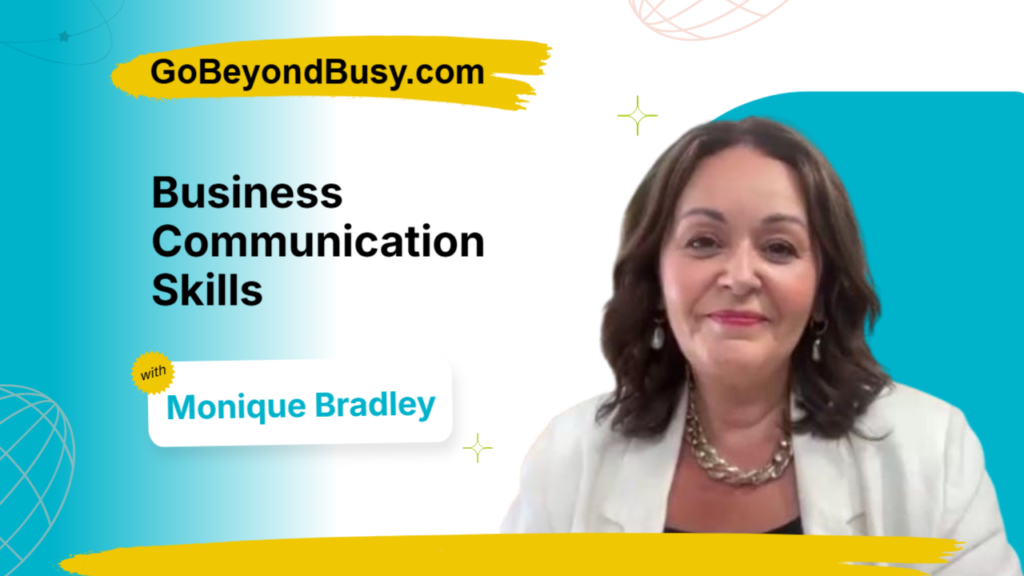
Business communication skills are often treated as something nice to have. In reality, they sit right at the centre of how a business grows, how a team works together, and how clients decide whether to trust you.
In this episode of Go Beyond Busy, I spoke with Monique Bradley, a communication coach and keynote speaker who has spent years helping people become more confident, clear, and authentic in the way they speak and show up in their business.
What came through strongly in our conversation was this. Communication is not just about what you say. It is about how you think, how you see yourself, and how willing you are to back your own ability.
Why Business Communication Skills Matter More Than You Think
Many small business owners focus on marketing tools, systems, and tactics. These all matter, but none of them work well if the communication behind them is unclear or hesitant.
Monique explained that communication sits underneath three key areas:
- Leadership – how you guide your team and set direction
- Sales – how you explain your value and build trust
- Visibility – how you present yourself online and on camera
If any one of these areas feels harder than it should, there is often a communication issue sitting underneath it.
Confidence Comes From Doing, Not Waiting
One of the most useful ideas Monique shared is that confidence is built through competence, and competence is built through repetition.
That means confidence is not something you wait for. It is something you build by doing the thing, even when it feels uncomfortable at first.
This applies whether you are speaking to a client, recording a video, or presenting to a group. The more often you do it, the more natural it becomes.
Backing Yourself in Business
A theme that ran through the entire conversation was the idea of backing yourself.
It is easy to get distracted by new opportunities, new ideas, or what other people think you should be doing. Many business owners end up taking on work that they can do, rather than work that actually fits them.
Monique’s perspective is that real progress comes from recognising your strengths and staying aligned with them. When you do that, your communication changes. You sound clearer, more confident, and more certain.
Clients notice that. Teams respond to it. Referrals become easier.
Communication and Video for Small Business Owners
Another area we discussed was video. Many business owners know they should be creating content, but feel uncomfortable being on camera.
Monique explained that speaking to a camera is a different skill from speaking to a room. It takes practice to feel natural, and it takes a shift in mindset to remember that you are speaking to a person, not a lens.
As more businesses rely on content to attract leads, this becomes harder to avoid. The businesses that are willing to show up and communicate clearly tend to stand out.
Helping, Not Just Promoting
One of the simplest ways to improve your communication is to focus on being useful.
Monique shared a straightforward idea. People are usually looking for one of two things online:
- Help
- Hope
When your communication is built around one of those, it becomes easier to connect with people and build trust over time.
Where to Start
If you are thinking about your own business communication skills, a good starting point is to ask yourself a simple question.
Are you saying what you really mean, in a way that people can understand and act on?
If the answer is not always, then this is an area worth working on. It does not require a complete overhaul. Small improvements in how you communicate can have a noticeable impact across your business.
Contact Monique at https://moniquebradley.tv
If you would like help improving how your business communicates, from your messaging through to your systems and processes, you can also book a free Business Strategy Session.
Want to read the transcript?
Welcome and Guest Intro
[00:00:00] Bernard: Welcome to Go Beyond Busy: The Small Business Growth Podcast.
Today Christine is joined by Monique Bradley, a communication coach and keynote speaker who helps people build confidence, speak with clarity, and show up authentically, whether that’s on stage, on video, or in everyday business conversations.
In this episode, they talk about backing yourself, finding your true strengths, and why communication skills matter far more than most business owners realise.
[00:00:30] Christine Abela: Hello, I’m Christine from Go Beyond Busy. I’m here today with the lovely Monique Bradley who is in Auckland in New Zealand. And; you are in Auckland, aren’t you? Yes.
[00:00:41] Monique Bradley: I am. I am.
I sure am. Love Auckland. Very sunny here.
[00:00:45] Christine Abela: I was just thinking you might be one of those places just outside Auckland that doesn’t like to be called Auckland. But no, you’re in Auckland.
[00:00:52] Monique Bradley: I’m definitely in Auckland, right on the city fringe, but I am a Wellingtonian at heart
Back Yourself in Business
[00:00:57] Christine Abela: Ah, very good. Today I’m going to have a wee chat with Monique, and I’ve got a question for you, Monique. What have you learned about running a business that you wish you’d known earlier?
[00:01:08] Monique Bradley: To back yourself.
So I know that sounds really short, but there have been so many times in my life where I think I’m on that right track, and then I’ve questioned my confidence or my ability, my competency. Or another sparkly thing has turned up in my peripheral and gone, maybe you should be doing this. But I’ve always come back to the one true course of work that I do now, and I wish I had have known that 25 years ago when I was starting my entrepreneurial journey.
[00:01:40] Christine Abela: How do you know which is your one true course? Because the sparkly thing might be the one true thing.
[00:01:45] Monique Bradley: Yeah, a very, very good point. For me it’s been about lots of failures and learning from failure. There’s that term fail forward fast, which isn’t about just doing another amazing thing and then going, oh yeah. Oh, it’s actually about having the courage to go, you know what, that doesn’t serve me. It isn’t in alignment. It might be an area of, of competency, but it’s not my area of true genius. And so for me, this concept of backing yourself, which is actually what I talk about as a keynote speaker as well, is, is really about going, no, you know what? I know who I am, know who I serve, and while I can do lots of things, it’s about, like they say, stick to your knitting.
Because that’s actually where flow happens. I believe flow happens and where you appear your sparkliest brightest, best self, and that’s what really people want to buy. They don’t want something that you can do because, oh, I suppose I better do it. People don’t align with that. They don’t resonate with that energy.
What they want is somebody who goes, yeah, I can do this and I can get this sorted for you, and here’s how I’m gonna help you. They want that level of excitement and authenticity. So backing yourself and staying on track with what your passion and your purpose and your mission and your vision really is.
Finding Your True Genius
[00:03:08] Christine Abela: Who can you get to help you with that sort of thing? You can listen to friends and things like that, but every friend and every mentor and everybody else has got their own agenda. So how do you know who will actually help you with it?
[00:03:21] Monique Bradley: Such a good question. I have over the years, realized that I’m an experiential learner. So I have people that I know who tell me that they learn best through watching the mistakes of others. I, it turns out I’m not that person. I have lots of people in my life who have told me that they, they learn by reading and they learn by, you know lots of different things.
I’m definitely experiential in the fact that I am a very much a, “I’m just gonna try it and see what happens” kind of person. So rather than, and probably much to my detriment, rather than listening to lots of other people, I’ve learned to listen to myself.
And so now even in the work that I do, so keynote speaking and also coaching. In the coaching space, in, in the work that I do, it’s very much about reminding people of how to trust their inner authority and what that looks like. And when, when it goes off track. And moving people from being, I guess a supporting character in their life and to being the central character of their life. I come from theater, so I think in theatrical terms.
And so I’m thinking, you know, how do we show up authentically, cause that’s a lot of what I speak on. How do we, how do we speak authentically? How do we communicate authentically, all of that sort of stuff.
And if we are not in alignment with ourselves, I know I’m going off track, but I’m coming back on track. If we’re not in alignment with ourselves, then the output or the way that we communicate doesn’t come across as congruent as an example.
So learning to trust yourself and back yourself, I think are the keys to success.
Monique’s Origin Story
[00:05:02] Christine Abela: How did you find out what your area of genius was? Were you a precocious child?
[00:05:10] Monique Bradley: It may surprise you, but yes, I was.
[00:05:13] Christine Abela: Doesn’t surprise me at all, Monique.
[00:05:15] Monique Bradley: Well, actually, let me, let me give you the truth. I was born, definitely born with a million words inside my body. I have learnt as an adult that some may call that ADHD. I call it neurofabulousness. And I, I see that part of my personality as such a gift.
So yes, a lot of words, but like a, a lot of kids, unfortunately, I was quite badly bullied, and so that really affected my confidence. So my parents who met in performing arts, they decided, well, what are we gonna do? How are we gonna channel all these millions of words with this child who was a little bit scared to sort of put them themselves out there.
So they, they literally got me into speech and drama when I was eight years old. And that started me getting into competitive speaking and acting.
So it started with elocution lessons and I learned to speak like the queen. And then I, I ended up doing a lot of competitions and doing a lot of examinations through Trinity College of London and New Zealand Speech Board, which is what it was called at the time. Started training as an opera singer because of course when I was 11 I started tap dancing, I think when I was 10.
So everything around that stuff was all incremental learning of skills to help me find my confidence. So in the work that I do, I teach that confidence is built through competence, and competence is built through repetition.
And so whatever thing you do over and over again, when you become competent at it, it will build your confidence. So got into the work that I do that way and ended up, it became an obsession. So I did everything I could in school that wasn’t classroom work. So every extracurricular activity in the arts that I could ’cause that’s where my passion was. And then followed that into doing a degree in theater and film, studying at TVNZ at their television training school. ‘Cause I loved all areas of television and communication. Then worked in retail, ’cause that’s what you do when you’re an actor in New Zealand, and learnt about communication for sales, which was really valuable.
But the common thread through everything that I’ve done throughout my entire life from being a child, through to being a magician, through to running a performing arts school, building and running a performing arts school, through to working in TV shopping across New Zealand and Australia. Through to running a digital agency with my partner Pete. Through to now the work that I do, which is in communication, keynote speaking, communication coach, and also as a national trainer for BNI New Zealand.
All of that stuff comes back to one thing. It’s about the stories that we tell and the way that we communicate. And so that’s really been my one true love my entire life. And there’s that thing that they say when you, when you live your passion or you know, you do a job, you love it, you’ll never work a day in your life. I’m not gonna lie, I get tired. But I operate in the workspace from a place of honour and gratitude because I really do feel so blessed that I now am not in those realms of competency going, I suppose I should. I get to live a life that serves others, helps them find their confidence, and I get to use my gifts.
So it’s really about trusting yourself and backing yourself and having an honest conversation with yourself. You know, having a meeting with yourself and going, you know, that work that I’m doing, is that really me? And if it’s not, what are you gonna do about it? So I’ve been a serial reinventor my entire life going, cool, is this working for me? If not, what’s the next step? So yeah, that’s kind of how I learn and how I’ve grown in my entrepreneurial journey, really.
What Her Coaching Covers
[00:08:50] Christine Abela: Tell me more about the coaching. Who do you coach and what sort of coaching do you do?
[00:08:55] Monique Bradley: Such a good question, Christine. You’re asking me great questions.
The coaching that I do, the core of it, people want to become better speakers, and that’s one thing we know about BNI as well is that people come into BNI for three reasons. One, they want to build their network. Whatever that means to them or do more networking.
The second thing that they want is they want a referral pipeline, which, you know, BNI is a referral networking organization.
And the third thing they actually want is public speaking skills. So every week through getting up and doing your one minute presentation, you inevitably become a more confident communicator.
And so for years I have taught public speaking technique. For a long time I didn’t want to. And then I saw so many people who would say, I’m just terrified of having an honest conversation, or I’m terrified of, I have to speak at my kids’ PTA meeting or I have to speak for an organization.
And that morphed into, ending up in the corporate leadership space, coaching senior leaders who all of a sudden have been great at the work they do, and now have to speak to 700 people at a conference and have never done that before.
I’ve coached a lot of firefighters. Who are extraordinary humans who serve their communities and end up in leadership roles. And they’ve been great at what they do, but again, have that struggle of addressing people.
And so I’ve looked at the three core things behind public speaking. So one of them is obviously the confidence in the self-belief. So I’ve done a huge amount of research into the formation of self-belief and confidence.
And then the other two things that support that are what we say, and how to say it. So those three core things form the basis of all the coaching work that I do.
So some people, I’ll spend more time looking at the self-belief piece and we, we look at the stories ’cause our belief is a story we tell ourselves over and over again. So we dive a bit more into that and they actually find quite often that that becomes content that they talk about. So it’s quite a cool narrative transformation process.
And then some of those people who come to me for confidence coaching, they end up going down their own speaker journey as well. So that’s been a beautiful, a beautiful journey to have.
Some people are emerging speakers, some are experienced speakers, and they want to grow a speaking business. So I kind of coach right through that. Anything to do with communication. If there’s a story to be told, I’m there for it.
Communication as Influence
[00:11:21] Christine Abela: The audience for this podcast series is mostly small business owners, so I’m thinking that perhaps you could also help with things like the people who want to appear on video or make their own promotional videos. And maybe even help with communication within a business, not so much the public speaking, but the getting your point across to employees or colleagues or suppliers and customers.
Am I on the right track here as well?
[00:11:51] Monique Bradley: 100%. I did a Master’s in Creative Practice with Unitec. I graduated last year with first class honors, and I’m the first person in the world to focus on a master’s on keynote speaking. Because I wanted to understand how we use speaking as a way to connect with people; what that looks like, looking at different influences on speaking, different models that we can lean on. And I even created my own model using teo Maori principles, and it was fascinating.
One of the key things that I learned through that journey was that speaking is an act of influence. Leadership is an act of influence. Sales is an act of influence. If you improve your communication and public speaking skills, you’ll become both a better leader and better at sales.
And so those I believe are the most important things, particularly for a small business owner. So if you need to interface with humans, or you’ve even got a team, a small team that need to interface with humans, public speaking and communication skills are labelled as soft skills. They are not a “nice to have”. They are an essential life skill.
And so that sort of thing is super important. And now we are moving into this era of, we’ve seen for many years, the marketing plans for a lot of businesses to be able to get cut through. They’re using digital platforms. And what they’re doing is they’re humanizing the brand by showcasing the people within that brand.
So suddenly a business owner who might have been behind the scenes who does a great job of their business and they might even have a team now, are suddenly having to become a thought leader or having to become the face of the business. So learning to humanize yourself again and to be brave enough to go on camera is a massive stepping stone for somebody who may never have been on camera before.
So some of the coaching work that I do is, is designed to get them on camera. Oh, are you pointing at yourself?
Getting Comfortable on Camera
[00:13:43] Christine Abela: I am pointing at myself because that’s exactly how I felt when I first started doing podcasts.
[00:13:48] Monique Bradley: And how, how has that been for you?
[00:13:52] Christine Abela: it’s been interesting. I’ve had to get over the idea of what I look like. I’ve had to get used to this is my face and this is what I look like and live with it, that’s it. I was also thinking about what do I wear?
So I now wear the same thing every episode. I wear this skivvy in every episode and I don’t have to think about what I wear. I’ve had training from somebody within BNI on making my background personal.
[00:14:19] Monique Bradley: You’ll see my background is personal as well. This is actually my lounge, but it’s also a TV set. So we actually film content for TV and interviews, for podcasts thought, leader content, thought leadership content.
In my house, I have, if I was to turn my camera around, there’s lighting everywhere. It’s a bit odd for most people to have that in their lounge. Like I don’t have a dining room table. But what I do have is the space where people can come in and learn these skills because they’re not skills that we are born with.
Well, I was born with a million words, but knowing how to structure them in the right way, that is a learned behaviour. Communication is a feedback loop between the sender and the receiver and learning those nuances of how that communication happens.
And more weirdly, learning how to communicate through a camera in a way that the other person at the other end, especially in a situation where you don’t have an audience in front of you or you don’t have an interviewer or interviewee in front of you. Learning to trust and again, back yourself, that when you’re speaking through the lens, you’re not just speaking to a hole in the front of the camera, you’re speaking to a human. And bringing that to the camera, that’s a whole learned skillset in itself.
So as an example, some people are great speakers to a room and really struggle to go on camera and you’d think, oh no, it’s the same skillset. No it is not. And then I’ve worked with some people in television who are wonderful on camera and will freak out if they have to speak in front of an audience.
All of these things are learnable and a necessity for any small business who is looking at marketing themselves. Employee generated content. User generated content. The most important thing is being authentic and going on camera and sharing your value, sharing your knowledge, sharing your expertise, being of service.
So the one thing that I know, especially after working in digital for 11 years, there are two things that people are looking for when they’re looking online, and it doesn’t include funny cat videos. They’re either looking for hope or they’re looking for help. And if you as a content creator or a business owner can show or demonstrate that, you are more likely, and I’ve seen the stats, to attract organic leads into your business. That’s just how it works.
Content That Builds Trust
And the cool thing is too, you know, we are part of a referral networking organization. When you share a piece of content which is really helpful, and you might talk about that same point in your networking meeting, it is really easy then for your members to be able to share that content out to their networks too, if it’s helpful for the people they’re connected to. So content, content, content, content, it works. One of the best things you could do for your business.
Biggest Wins and Impact
[00:17:04] Christine Abela: I loved hearing about your master’s degree. Is that your greatest success?
[00:17:10] Monique Bradley: Such a good question. There have been many incredible successes, and I believe that the key to building confidence is to celebrate the wins because it reminds your brain you’re on the right track and to keep moving forward.
I built a performing arts school in three days and I went from 10 students to a hundred students in two school terms. So that was an incredible success about building community.
When I had my digital agency and after I finished my contract of working as a TV shopping presenter, my partner Pete, built the studio that I’m sitting in today. And he built that for me because he said, you’re really good at that. And from that moment we started live streaming. So this was 2016 before live streaming ever happened in New Zealand.
And I lent on the work I’d done as a magician, so I did a Sunday morning kids show. And then the rest of the time it was all the stuff I did on TV shopping, which was largely advertorials and infomercials. And we sold a ton of products and that attracted some of the biggest clients that I’ve ever worked with, like Dilmah, De’Longhi, Kenwood, a bunch of really big organizations.
Through that experience, I’ve reached 200 million people. So that’s one of the biggest things that I’ve ever done.
I sang for an event in Wellington. We had 40,000 people in the audience. That’s another big thing.
But the biggest thing of all, and I guess it comes from these extraordinary things that I’ve done within my life, is when I go to an event, and somebody can address me by name, go, “Monique, thank you for the content that you share”. “Thank you for the advice that you share, because I now feel more confident to be myself”.
That out of all of these things, these extraordinary things, and I’ve done a ton, but that feeling for people to have confidence in themselves, I think is by far my biggest achievement.
Wrap Up and Next Steps
[00:19:07] Christine Abela: Thank you very much, Monique Bradley, it’s been lovely talking with you. I’m Christine from Go Beyond Busy. I’ll be putting Monique’s contact details under this video, and if you want to contact me and to have a free business strategy session, I’m happy for you to reach out. Thank you, Monique.
[00:19:23] Monique Bradley: Thank you.
[00:19:24] Bernard: If you’d like to take the next step, head over to GoBeyondBusy.com.
There, you can book a free Business Strategy Session with Christine, or find Monique’s contact details and connect with her directly.

5 April 2026 · Season 3 : Season 3 · Episode 14
19 Min, 39 Sec · By Christine Abela
Strong business communication skills build confidence, improve sales, and help small business owners connect with clients and teams.