TL;DR: AI tools like ChatGPT and Perplexity are now recommending specific businesses to people searching for help. If your business is not being named, the fix is not a technical trick. It is clearer, more specific content that directly answers the questions your ideal clients are already typing. Here’s what you need to know about AI search optimisation for small business in New Zealand.
-
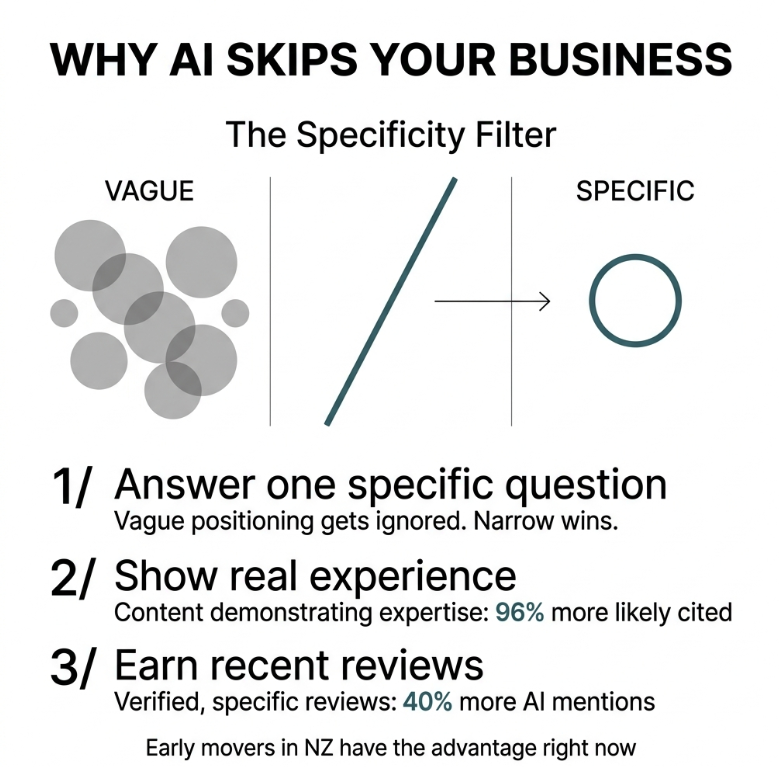
AI recommends businesses that answer a specific question clearly, for a specific person, in a specific place.
-
Vague positioning gets you skipped. Narrow, honest positioning gets you named.
-
Content showing real experience is 96% more likely to be cited by AI systems.
-
Verified, recent reviews give businesses 40% more mentions in AI answers.
-
Early movers in NZ have a real advantage right now, because most small businesses have not adjusted yet.
A small business owner rang me last month. She runs a small manufacturing business in South Canterbury (NZ), and turns over a few million a year. Her husband does the hands-on trade side, she quietly inherited the online side of things.
She said: “I typed the problem we help with into ChatGPT and asked who could help. A firm in Auckland came up. We’d never heard of them. Why not us?”
That question stuck with me. Because I have been here before, with search engines, then social media, and now AI. The answer is always a version of the same thing.
How AI Decides Who to Recommend
An AI recommends you for the same reason a trusted colleague recommends you. You gave a clear, specific, honest answer to a specific question. The machine is just the newest party at the table, repeating what already seems to be trustworthy and precise.
I have been advising clients on this since search engines first arrived. Each new discovery platform announces itself as a revolution, then quietly rewards the same fundamentals: clarity and earned trust.
AI works the same way. It just exposes vague positioning faster than any human ever did.
Bottom line: AI search optimisation for small business is about being genuinely clear, not about gaming an algorithm.
Why That Auckland Firm Got Named (and They Did Not)
The firm that came up in her ChatGPT search had done one thing well. They answered a narrow question clearly. They said exactly who they help, where, and with what.
More than half of searches now end without a click. People get their answer straight from ChatGPT, Perplexity, or Gemini. If you are not in those answers, you are invisible to a large portion of people actively looking for what you do.
The queries have changed too. People no longer type “business consultant”. They ask full questions like “What are some good business consulting services that specialise in helping small businesses grow online in New Zealand?” Answer engine optimisation rewards content that matches that kind of question, in plain human language.
Key Point: Specificity is what earns the mention. A specialist who answers one narrow question well will be named before a generalist covering everything.
Why Qualifiers Are Your Best Friend
Look at the question my caller asked. It carried three qualifiers: small businesses, grow online, and a place. Every qualifier narrows the field, and every narrowing is a chance to be the precise answer.
For years I felt the pull to say I serve everyone. But then I learned to name exactly who I help and where. Better clients came from that than from casting wide ever did.
So here is what I am doing about it, and what any small business owner in New Zealand or Australia can do too. These are the AI search optimisation steps that actually work, based on the same fundamentals that have driven discovery since the first search engines arrived.
1. Answer the Exact Question, in Writing
Put the real question on your site, then answer it plainly. Who you help, where, and the specific problem you solve. For me, that is small business owners in New Zealand and Australia, turning over between one and ten million, who want to grow online without drowning in the tech.
AI needs to understand your business before it recommends you. If it cannot read a clear answer, it moves on to the business that gave one.
2. Let Your Experience Show
Content that shows real experience, expertise, and trust is far more likely to be cited by AI systems. In one analysis it was 96 per cent more likely to be picked up than content lacking those markers.
Ranking first on Google does not guarantee you get named in an AI answer. Lived experience does. Decades of building websites, fixing marketing, and sitting across the table from business owners is exactly the kind of substance a machine reaches for.
3. Get Real Reviews, and Keep Them Recent
Businesses with verified, recent reviews get 40 per cent more mentions in AI answers. The machine reads your reviews and uses them to decide who it trusts enough to recommend.
Ask your happy clients to write one. Ask them to be specific about what you fixed. General praise helps less than a clear line about the exact problem you solved.
A tip: one honest, specific review beats ten vague five-star ratings. Specific tells the machine what you actually do.
Key Point: AI systems treat reviews as evidence of real expertise. Vague praise gives them nothing to work with.
The Window Is Open Right Now
Small businesses in New Zealand have not broadly adjusted for this yet. That means there is a real opportunity for the ones who move early and build authority before the crowd catches on.
Results take time. Early wins tend to show within eight to twelve weeks, with the fuller picture over four to six months. This is not a quick fix, and I would not sell it as one.
Be careful of anyone promising guaranteed AI rankings or overnight results. There is no setting that games this. The businesses that get named are the ones that earn it, the same way they always have.
Key Point: Moving early on AI search optimisation is a genuine competitive advantage in New Zealand right now. That window will not stay open indefinitely.
What This Means for Your Business
You get named by AI the same way you get named by a trusted colleague. By answering one specific question, for one specific kind of person, in one specific place, more clearly and honestly than anyone hedging their bets.
My advice is the same today as it was in the mid 1990’s when we first started using search engines. Be clear about who you help. Be honest about what you do. Say it in plain English, and keep saying it consistently, until the machine and the market both learn to trust you.
If you want a hand doing that for your own business, that is part of the work I do at Oxygen8. AI search optimisation for small business in New Zealand is a core part of what I offer. No hype, no shortcuts, just clear steps that keep working after we have set them up.
Frequently Asked Questions
What is AI search optimisation for small business?
It is the process of making your business clearly visible and citable when AI tools like ChatGPT, Perplexity, or Google’s AI Overviews answer questions from potential clients. It focuses on clear positioning, specific answers, and earned trust signals rather than keyword tricks.
How is AI search different from regular SEO?
Traditional SEO targets keyword rankings in a list of links. AI search pulls direct answers and recommends specific businesses by name. Ranking first on Google does not guarantee you get named in an AI answer. Content that demonstrates real expertise and specificity does.
How long does it take to show up in AI search results?
Early improvements tend to show within eight to twelve weeks. A fuller result takes four to six months. There are no shortcuts, and anyone promising overnight results is not being straight with you.
Do reviews really affect whether AI recommends my business?
Yes. Businesses with verified, recent, and specific reviews receive significantly more mentions in AI answers. One detailed review explaining exactly what problem you solved is more useful than ten generic five-star ratings.
Does my business need to be in Auckland to benefit?
No. Specificity about your location, whatever it is, is an advantage. AI rewards businesses that are clear about who they serve and where. A business in Timaru or Christchurch that answers a narrow question precisely can outperform a vague Auckland firm.
What kind of content does AI prefer to cite?
Content that directly answers a specific question, in plain language, from a source that shows real experience and expertise. Short, clear answers beat long, vague pages every time.
Is this something a small business owner can do themselves?
The core steps are straightforward. Write down who you help, where, and what problem you solve. Put that on your website clearly. Ask clients for specific reviews. Show your real experience. You do not need a big budget, just clear thinking and consistent follow-through.
Key Takeaways
-
AI tools recommend businesses that answer a specific question clearly, for a specific person, in a specific place.
-
More than half of searches now end without a click, making AI visibility critical for small businesses.
-
Content demonstrating real experience is 96% more likely to be cited by AI systems.
-
Verified, recent, and specific reviews give businesses 40% more AI mentions.
-
Small businesses in New Zealand have a genuine first-mover opportunity right now.
-
There are no shortcuts. AI rewards the same things a trusted colleague rewards: clarity, honesty, and specificity.
-
The fix is not technical. It is being genuinely clear about who you help and what you do.