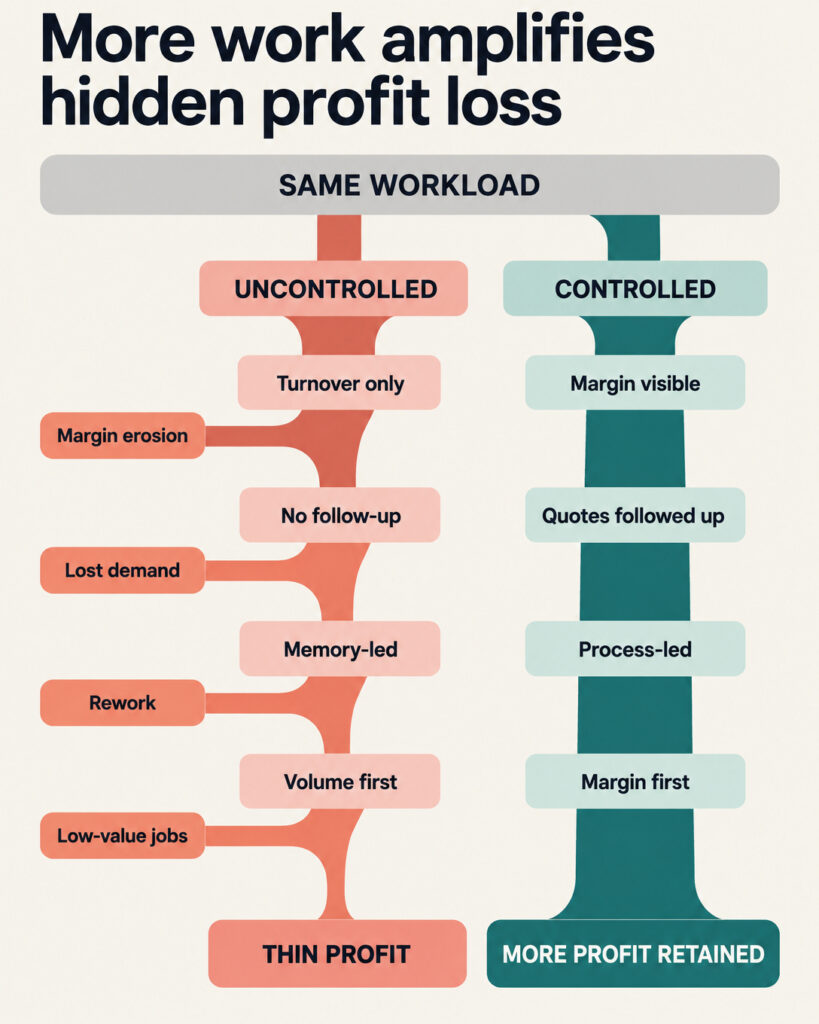
TL;DR: If your business is busy but not profitable, the leak is usually somewhere in how it runs day to day. The usual culprits are untracked numbers, quotes with no follow-up, and processes that live in one person’s head. Working harder just pushes more money through the same holes. A structured business assessment shows you where they are, so you can fix them one at a time.
Being busy tells you how much you’re doing. Profit tells you what you keep. A full diary can hide a thin margin for months before the accounts show it.
The usual leaks are no KPI tracking, reports that look tidy but mislead, enquiries with no follow-up, processes stored in someone’s memory, and effort going into low-margin jobs.
More hours and more software won’t plug them, because automation speeds up whatever process is already there, muddled or not.
A structured business assessment finds the leaks, so you can decide what to fix first.
Over the years I’ve sat with plenty of business owners who work long days, answer every call, and still feel a bit sick when they check the bank balance at the end of the month. The work’s there, and so are the customers. But the money is somehow thinner than all that effort says it should be. If that’s you, you may have told yourself it’ll come right once this busy patch is over. Busy but not profitable is a frustrating place to be, and it’s usually fixable.
Why can you be busy but not profitable?
Being busy tells you how much you’re doing. Profit tells you what you actually keep. And those two can drift a long way apart without anyone noticing, because a full diary feels like proof the business is going well. By the time it shows up in the accounts, the habits behind it are well set in.
So the useful question is a quiet one. Where, exactly, is the money leaking out?
Key point: A full diary and a healthy bank balance are two different measures, so check both.
Where does small business profit actually leak out?
When owners think about lifting profit, they usually think about winning more work. More leads, more quotes, more hours. But in my experience the problem often sits inside the ordinary running of the business. It’s in the bits nobody looks at, because they seem too boring to matter.
These are the leaks I come across most often:
Numbers nobody tracks. If you can’t name the three or four figures (your KPIs) that tell you whether the business is healthy, you’re steering by feel. And feel is a pretty rough instrument.
Numbers that look tidy but mislead. A neat report can still be measuring the wrong thing. Turnover can climb while the margin on each job quietly shrinks.
Enquiries that go nowhere. Someone rings, gets a quote, and hears nothing more. That follow-up call costs almost nothing, and it pays better than most advertising. It’s also the first thing to slide when things get busy, which is a bit backwards when you think about it.
Work that lives in one person’s head. If a process only exists in your memory (or your best staff member’s), every job gets done a bit differently. Rework eats the margin.
Effort going to volume instead of margin. Some jobs keep you busy and barely pay. Without the numbers in front of you, they look just like the good ones.
On their own, each of these looks small. Together, they explain how an owner can be flat out from seven in the morning and still wonder where the money went.
Key point: Profit usually leaks through several small, ordinary holes at once, so look at the routine stuff before you chase more work.
Why doesn’t working harder fix it?
The natural response to a thin bank account is to push harder. More hours, more jobs, more hustle. But if the leaks are in how the business runs, extra volume just pushes more money through the same holes.
What about buying new software?
Other owners reach for software as the fix. A new quoting app, a new invoicing system, a bit of automation on top. My rule here is simple: don’t automate chaos. Automation speeds up whatever’s already there. So if the process underneath is muddled, you get the same muddle, just faster.
💡 Tip: before you buy any new tool, write down the process it’s meant to run. If you can’t write it down yet, the tool has nothing solid to work with.
Key point: More hours and more tools both make existing leaks bigger, so sort the process before you speed it up.
How does a structured business assessment help?
The honest difficulty is you can’t see these leaks from inside the day-to-day. You’re too close, and too busy. They hide in routines that feel normal because they’ve always been done that way.
That’s why I put so much weight on a structured business assessment. In my Get Your Business Sorted framework, the starting point is a Business Snapshot, then a fuller Business Assessment. It’s a set of questions that walks through every part of how the business runs. The questions are there for diagnosis, with no blame attached. You’re just finding out what’s actually happening, rather than what you assume is happening.
Once the leaks are visible, they turn into decisions. You might decide to track four meaningful numbers instead of none. Or that every quote gets a follow-up within a week. Or to finally write down the process that lives in your head. It’s unglamorous work, and every bit of it keeps money in the business.
Key point: A structured look shows you what’s really happening, which turns a vague worry into a short list of decisions.
Where should you start this week?
You don’t need to fix everything at once. Trying to is just another way of staying busy but not profitable.
Pick one leak. Look at your last twenty quotes and count how many got a follow-up. Or sit down with your accountant’s figures and check whether your margin per job matches what you assumed. One honest look at one small area will tell you more than another sixty-hour week.
Key point: Start with one leak and one honest check. You can do it this week, on your own, with figures you already have.
FAQ: busy but not profitable
Why is my business busy but not profitable?
Usually because profit is leaking through small, everyday holes. Untracked numbers, quotes with no follow-up, processes in one person’s head, and low-margin jobs eating your time.
Which KPIs should a small business track?
Start with the three or four figures that tell you whether the business is healthy. Include margin per job, because turnover can climb while margin shrinks.
Will automation fix my profit problem?
Not on its own. Automation speeds up whatever process you already have, so a muddled process just gets muddled faster. Write the process down first.
What is a structured business assessment?
A set of questions that walks through every part of how your business runs, so you see what’s actually happening rather than what you assume. In Get Your Business Sorted, it starts with a Business Snapshot and then a fuller Business Assessment.
Why can’t I spot the leaks myself?
You’re too close and too busy. The leaks hide in routines that feel normal because they’ve always been done that way.
How quickly should I follow up a quote?
Within a week is a good rule. That follow-up costs almost nothing and pays better than most advertising.
Where do I start?
Pick one leak. Count how many of your last twenty quotes got a follow-up, or check your margin per job against what you assumed.
Key Takeaways
You can be busy but not profitable for months, because busy and profitable are measured differently.
Profit leaks are usually small and ordinary: untracked KPIs, misleading reports, no follow-up, processes in one head, and low-margin work.
Working harder pushes more money through the same holes.
Don’t automate chaos. Get the process clear first.
A structured business assessment turns guesswork into decisions.
Fix one leak at a time, starting this week.