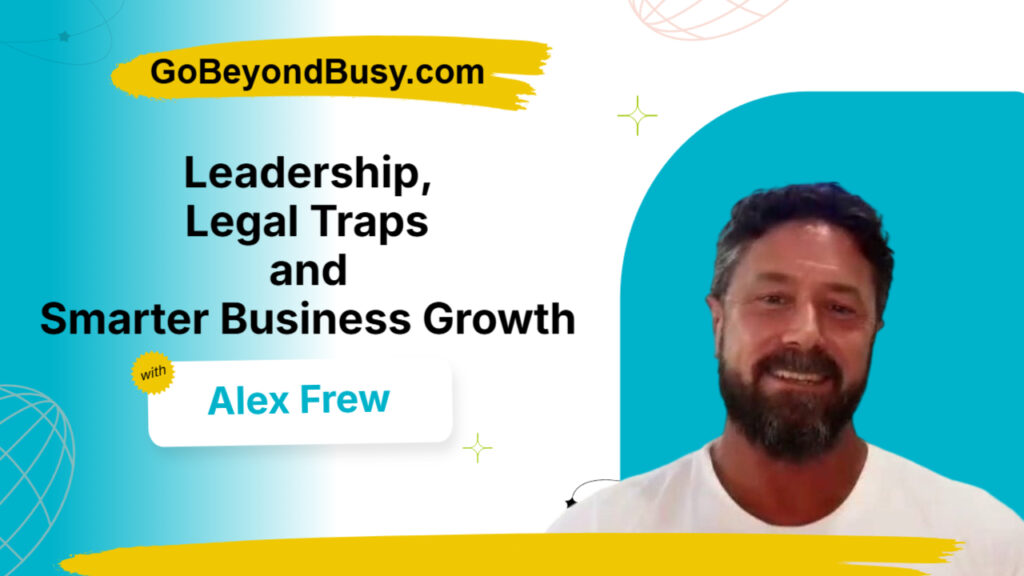
In this episode of Go Beyond Busy, Christine Abela chats with Alex Frew from 3P Digital, a seasoned entrepreneur based on the Gold Coast, Australia. Alex shares hard-won lessons from building businesses across multiple countries, including his take on legal agreements, missteps in delegation, team motivation, and financial misunderstandings.
You’ll hear how legal oversights nearly cost him everything, why money rarely motivates the way you think, and what founders often get wrong about hiring and growth. Alex also explains how he now works with business owners as a fractional CMO, bringing deep strategic marketing insight without the traditional agency fluff.
Whether you’re just starting out or scaling fast, Alex’s candid insights will help you avoid painful mistakes and grow a more sustainable, profitable business.
Learn more about Alex at: https://fireyourdigitalagency.com.au
Want to read the transcript?
Introduction to Go Beyond Busy
[00:00:00] Bernard: Welcome to Go Beyond Busy. The podcast for small business owners who are ready to slow down, breathe, and bring calm clarity to the way they work and grow their business.
In this episode, Christine talks with Alex Frew from 3P Digital. Yes, there is a strange noise in the background during the interview, but if you stick around until the end you will find out what it was.
[00:00:24] Bernard: Here’s your host, Christine Abela.
Meet Alex Frew from 3P Digital
[00:00:27] Christine Abela: Hi, I’m Christine Abela from Go Beyond Busy. I’m here with Alex Frew, who runs a business called 3P Digital, and he is on the Gold Coast in Queensland, Australia. How are you, Alex?
[00:00:39] Alex Frew: I’m doing really well.
[00:00:40] Christine Abela: So tell me, what have you learned about running a business that you wish you’d known earlier?
[00:00:45] Alex Frew: That I certainly needed to have tougher skin and a harder heart. That is absolutely for sure. It’s never as easy as the dream it was to initiate that endeavour. But I think if I distilled it down, looking back on the last 10 years, and we would’ve employed across the group of companies anywhere between sort of 200 and 300 people.
We’ve had businesses set up in America, Canada, and in the Philippines. And out of all of that, the learnings that I’ve come down to really would be the mistakes that I made. And I think that’s how we all learn and they would be classified as people, money and my least favorite topic legal. So that would be the triangle of golden nuggets that I could give to my younger self would be those three things.
Lessons Learned: Legal Challenges
[00:01:31] Christine Abela: Tell me about the legal, let’s start with the hard bits first. Sorry, but let’s start there.
[00:01:36] Alex Frew: So legal really cost me the most, which is probably no surprise to people that have been involved with any legal matters, whether that’s just helping your own organisations bring in processes and streamlining your contracts, or if you’re actually engaging legal representation for business acquisition or disposal or engaging legal to pursue another matter. The lesson that I got from legal really were, I’ve started four businesses with co-founders and my co-founders were my people, inner circle, friends I trusted, people I spent years building dreams with. So much so that one of them was my fiancée and I operated on the belief that trust and shared ambition were enough, that the informal agreements and the promises, that mutual respect would carry us through. And they didn’t. When you start off and you have nothing, it is very easy to dream. But when the money grows, the pressure grows with it. And when that pressure grew, people changed. And when people changed the absence of that tight legal framework became the biggest risk to the business and the biggest risk to me personally. So I really wish that someone had told me on day one that, and this might sound probably a little bit too simple for some of the people that have had an eye on this from the start, but a handshake is not a shareholder agreement. Today doesn’t guarantee alignment tomorrow. Even down to roles and responsibility, equity splits, how you’re going to exit the business. They all need to be formalised before the emotions enter the room. People you love can make decisions that you never expected, once, money, power. And really when you strip that away it’s almost like insecurities come into it.
Money Matters: Insights and Reflections
[00:03:23] Christine Abela: What would you like to say about money. Since you’ve raised the topic.
[00:03:29] Alex Frew: I need more of it. So if any of your audience would like to give me some, that’d be great. Really, my takeaways from money is, it doesn’t motivate people the way you expect. My overarching “Why” as a person that I’ve been able to commercialise is to help people be more than what they ever thought that they could be. And in the early days, I genuinely believed that money was that ultimate lever to attract or to go and get whatever you wanted in your life. From our very first employees, I rolled out a profit share model for every staff member. Full transparency, monthly P&L meetings, coaching and roadmaps to achieve their big whys and their big goals in their life, the whole thing. But interestingly, instead of motivation, I got disappointment. People thought that profit share would make them feel valued and they would become rich overnight. And instead, I think it created more confusion, pressure on their side and resentment when they saw that the business was growing and we were moving into offices and we were employing more people. And it just left them with unmet expectations. So I think my takeaways from that were, most people don’t want a performance based upside. They actually just want certainty. And while incentives do work, I think they only work for the people that want the responsibility. And I think in most growing organisations where you’ve got a great solid bench strength and you’ve got some good team workers below them, you’ll always have these brilliant people that show up nine to five. They give you 80% of their work effort, and they’ll do that for 10 years, every day. And they are so valuable to your organisation and money really won’t unlock any more performance from them. What I found was that if they wanted more responsibility, it does help that. And also money, to me, money is not everything, but it unlocks everything for me. But it means a lot of different things depending on a person’s background, the relationship that they have with money also, just how they treat risk around money as well. A bonus can’t really fix that lack of clarity or their capabilities. So it taught me a lot about human behaviour. And I’m still learning about human behaviour and it certainly wasn’t in the way that I expected.
Hiring and Delegation Pitfalls
[00:05:43] Christine Abela: Cool. So one of the things that you said before we started this was that sometimes founders get things wrong with regards hiring and delegation. Can you talk about that a little bit? What do founders get wrong about hiring and delegation?
[00:05:57] Alex Frew: I’ve got a small sounding board of other like-minded founders and I might have been in a fortunate position that I worked for really one company before I started my own businesses. And I worked with them for 13 years. I started at the bottom and we were doing $5 million. By the time I exited that company, I led one of the largest acquisitions in New Zealand, actually, for the Konica Minolta business over there at 130 million. And I was leading just over 1100 staff. So I think probably the biggest two things that other founders I’ve seen get wrong. And I don’t believe that there’s, a black and white with running a business. But the things in my opinion is that they either delegate and they don’t correctly set up that person for success. So there might not be an operating procedure for their role, or they’ll say, go and do this, but they don’t know how to do it themselves. So it’s a little bit of they delegate without guidance. I think that can set up that person for failure, which is a detriment, not only to the owner, because then they can start being risk averse to delegating out, which means they’re cutting into their own time. And then the second lot is, as founders I believe that when we first started our business, we’re generally a sole trader, sole operator.
We might be fortunate enough that we have one or two other people around us, but intrinsically we’ll work harder than anyone else in the business and longer hours than anyone else in the business because if we don’t work, we don’t eat. And the second thing that I see wrong that founders do, or in my opinion is wrong, is that mindset follows a founder and you’ll see them being busy for busy’s sake. A lot of podcasts and materials touch on this, that at a point in time a founder will have bigger impact on their business by working on it than in it. And all too often I see founders working in it. And while it is dollar productive they might be doing that sales job or that customer service job or that operations job better than anyone else could. It certainly isn’t giving them the best return on their time investment in their business.
Understanding People in Business
[00:07:59] Christine Abela: You mentioned at the beginning that there were three things, and the first one was people. What would you like to say about what have you learned about people?
[00:08:07] Alex Frew: It rolls off back of my money lessons that in a successful organisation the co-founders or your leadership team, your bench, if you’ve got it right and you are incentivizing them correctly, I think that the two go hand in hand and that money can change people. And position and power, and I referenced money there, but I do think it’s more about position and power in terms of just the dynamic they have in the role. People that come from modest roles into an organisation that enables them and believes in them and grows them into more. I think that they can hold on to a little bit of fear in terms of now I have this, that I’ve never had it before, I might lose it all. And it doesn’t change who they are, but I think it amplifies everything about their new position in life, whether that is tied to money or power or respect. And it just brings fears, desires, and insecurities to the forefront. It creates a bit of a scarcity mindset.
I think that would probably be the number one thing that I’ve seen more often than not that is tied to people that have intrinsicly changed, but the position changes or amplifies who they are.
About 3P Digital
[00:09:22] Christine Abela: Tell me about 3P Digital. What do you do?
[00:09:25] Alex Frew: 3P Digital. So I’m in a really fortunate position now after 10 years of running other digital agencies. We’ve got a few thousand clients around Australia, a couple in New Zealand actually. And 3P Digital was a chance for me, ironically, since I just said that founders are always on the tools and that’s not the best place for their time, it’s enabling me to start working with other business owners to really tap into my why of helping them become more than they thought that they could be.
So I work with a small group of founders or business owners that have got big dreams. But realistic investment forecast to achieve those big dreams. So I’m really working with a great group of people around Australia predominantly now that we can work on, while it is mainly their digital acquisition part of the business.
So how do they get more branding? How do they get better return on their marketing investment? But it’s more an overarching, let me become a fractional chief marketing officer in your organisation, and I can bring my 20 years business experience in, and we can go and capture a new market or we can bring a product to market. We can just promote a product better. So yeah, this this is a passion project of mine on the Gold Coast near, near the surf, sand, sun. And I’m just absolutely loving working with business owners again.
Conclusion and Contact Information
[00:10:41] Christine Abela: That’s great. Thank you very much. I’ll put a link to 3P Digital, actually it’s FireYourDigitalAgency.com.au underneath this video. So that’s how you can get in touch with Alex. So thank you very much for joining me today, Alex, and we’ll see you on the next episode.
[00:10:57] Alex Frew: Thanks, Christine.
The Mystery Noise Revealed
[00:10:59] Bernard: And in case you were wondering what the strange background noise was during the interview…
[00:11:05] Christine Abela: And by the way, do you have a dog snoring or something?
[00:11:09] Alex Frew: Oh my God.
[00:11:11] Christine Abela: The dog snor through the whole thing.
That’s okay. And I might not edit this bit out ’cause that’s funny.
[00:11:23] Alex Frew: Heard and it’s not hard to hear. I think you just get desensitized to it.
[00:11:27] Christine Abela: Yeah. I could hear this noise and I’m thinking this, it sounds familiar. What is that noise? It sounds like a dog snoring, but that’s okay.
[00:11:35] Bernard: Thanks for tuning into Go Beyond Busy.
[00:11:38] Bernard: If you’re looking to grow your business and want expert guidance, visit GoBeyondBusy.com to apply for a no-cost Business Strategy Session on Zoom. Christine Abela is a business consultant and tech strategist who’s helped hundreds of business owners move from chaos to calm.
[00:11:56] Bernard: Want your business to run better, feel easier, and earn more? It all starts at GoBeyondBusy.com.