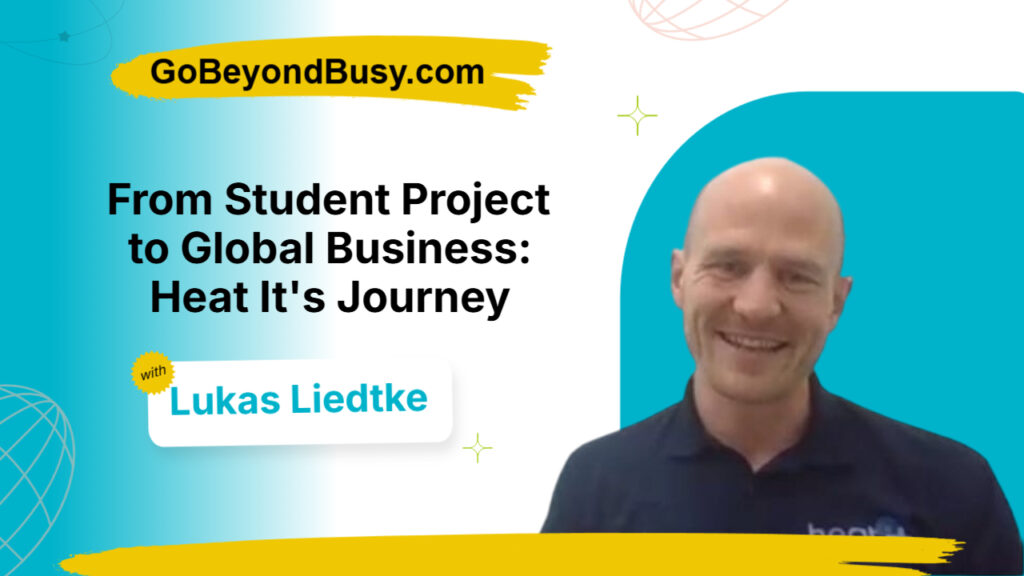
Lukas Liedtke shares how Heat It went from a student idea to a global brand helping millions treat insect bites with smartphone tech.
In this episode of Go Beyond Busy, Christine Abela interviews Lukas Liedtke, co-founder of Heat It, the innovative medical device that uses heat to stop the itch and pain from insect bites.
Lukas explains how Heat It started as a university project and grew into a product now sold across Europe, the United States, and New Zealand. He shares the science behind the device, the challenges of producing a Class 2a medical device, and the reality of scaling a hardware product worldwide.
You will hear how the Heat It team expanded internationally, the role of local partners in new regions, and why building a strong team early made all the difference. If you are interested in product development, global distribution, or growing a business from scratch, this episode gives you practical insights and real world advice.
To learn more about Heat It, visit https://heatit.de or the New Zealand distributor at https://heat-it.co.nz/
Want to read the transcript?
Introduction to Go Beyond Busy
[00:00:00] Bernard: Welcome to Go Beyond Busy, the podcast for business owners who want more time, more freedom and more growth without burning out.
In this episode, Christine speaks with Lukas Liedtke from Germany, co-founder of Heat It, a clever medical device that helps stop the itching and pain of insect bites using heat and your smartphone. They talk about growing a company from a student project into a global business, the challenges of international expansion, and the power of building a strong team early.
Let’s join Christine and Lukas.
Meet Lukas Liedtke and Heat It
[00:00:34] Christine Abela : Hi, I’m Christine from Go Beyond Busy. I’m here with Lukas Liedtke who is in Germany, and he runs a business called Heat It. How are you doing today, Lukas?
[00:00:44] Lukas Liedtke: Fantastic. Thank you so much for having me.
The Journey from University Project to Global Business
[00:00:47] Christine Abela : No problem. So tell me what’s something that you’ve learned about running a business that you wish you’d known earlier?
[00:00:54] Lukas Liedtke: I guess something I’d like to have known earlier would be to be more self-confident in employing people who know certain things better than I do. We started right out of university, so I was 26, I think, at that time. And so for a long time we worked with students and then built the company and so on.
And just over the past few years I experienced how much it accelerates our whole venture to have people on board who just know things better, who have talent in sales or marketing, or things that I or my co-founders might not have as much talent.
[00:01:33] Christine Abela : So you said you started straight out of university. What sort of talents did you have when you started?
[00:01:40] Lukas Liedtke: We are a team of four founders and we all studied mechanical engineering and so this doesn’t sound like a great team to start off with, especially in a consumer medical device. But it turned out that it was actually a good setup. We were good friends at that time and still are, and have different talents.
So we have some people who bring up new ideas and new project and new business partners and opportunities and other who bring it over the finish line and build a quality management system and so on. But maybe it would be good for the listeners to understand what we do first.
[00:02:14] Christine Abela : Yes please tell me what is that?
How Heat It Works
[00:02:16] Lukas Liedtke: So Heat It is a medical device that stops the itching and pain after an insect bite. Most kind of insect bites can cause itching and pain, especially sand flies or mosquitoes. And in Germany, devices got very popular over the years that are maybe this big, battery powered sticks. And they heat up a small portion of your skin to around 50 degrees Celsius, and that stops the histamine release and thereby the itching and pain. And I started loving the principle and the devices and at the same time, I never had them with me when I was traveling. So I thought, why not use a smartphone, which I have with me all the time anyways, and then build a tiny device that attaches to your key ring and can be simply plugged in the USB port of the phone.
And that’s what we did. And this is what’s still our main product.
[00:03:06] Christine Abela : For the people who are listening to the audio rather than watching the video, could you describe how small it is please? What are we looking at?
[00:03:13] Lukas Liedtke: So it attaches to your key ring and is maybe as big as the top half of my thump. So it maybe looks like a small memory stick. It has a USB-C connector on the backend, and then once plugged into the phone, it works with all kinds of phones, so iPhone or Android you plug it in there, it opens the little app. In the app, you can make some very simple selections. If you want to treat a child or adult, for example, you hit start and that brings up the device to 50 degrees Celsius. And the application itself is then very simple and straightforward. It only lasts four to 10 seconds, and that makes the itch go away, and that is all there is.
So this was a student project back in 2017 and then started to become an actual product in 2020.
[00:04:00] Christine Abela : Very cool. So how does it make the itch go away?
[00:04:05] Lukas Liedtke: That’s an excellent question. So your body reacts to this heat shock with the release of heat shock proteins. And these heat shock proteins stop the release of histamine. So it works similarly to an antihistamine cream and thereby stops the overreaction to the saliva of the mosquito and thereby the itch and pain. To be quite honest, it’s not super well understood how it functions on the cell level, but it is well understood the efficiency of the device itself. Not only us but also many other companies and scientific research companies have published papers and we’ve seen, for example, that within five minutes the itch reduces on average by 81%.
So very significantly in a very short amount of time.
[00:04:50] Christine Abela : I’ve got one of those skins that when something bites me, it bites me and bites me. I must have very tasty blood or something, and so when I get bitten several times, could I use this on all of those bites? Is that how it would work?
[00:05:06] Lukas Liedtke: Yes, definitely. And one common question we get is doesn’t it suck my battery empty? But you can do more than a thousand treatments with a single battery charge. So that’s actually no worry at all. I hope you don’t get a thousand bites. So then you should maybe not go outside, but you actually, quite right with your assumption. It has to do with your blood type and other factors. How often you get bitten by mosquitoes, for example.
[00:05:31] Christine Abela : And so you said that it’ll work for other insects. We have an area of New Zealand called the West Coast in the South Island, which is notorious for sand flies. Will it work with sand flies and other insects other than mosquitoes?
[00:05:46] Lukas Liedtke: The general principle is not dependent on the actual insect, so it does work and it reduces the histamine release as yes, it works, but maybe we should book a business trip to New Zealand and test it ourselves.
Global Expansion and Market Reach
[00:05:59] Christine Abela : Excellent idea. Very good idea. I agree. So where is it available? I know we’ve got a lovely lady in New Zealand called Monika who is selling this, and I’ll put the link to Monika’s website and your website underneath this recording, but where else is it available? Is it only available in Germany and New Zealand?
[00:06:17] Lukas Liedtke: No, it’s not. It’s been a bit of a journey. So we started, as I said, as a student project and then started with a crowdfunding campaign. And over the years it has now reached many people, especially in central Europe. So we’ve sold in the past three years alone, we’ve sold over 1.5 million units already and I feel now ready to expand internationally and Moni is our fantastic outpost in New Zealand.
So it’s available, I think heat-it.co. nz is a domain where you find the device and can order it. And in this way, we progress around the world. So we’ve incorporated, for example, in the United States where you find it in more than 200 stores already nationwide. In Germany we are in 9,000 pharmacies. It’s really available in many different stores and online, of course, from outdoor over consumer electronics to pharmacy and healthcare retail, very wide audience.
[00:07:19] Christine Abela : How have you managed that global expansion. What did that look like?
[00:07:26] Lukas Liedtke: I would like to tell you that it’s this beautiful plan and then we just execute one step at a time. But New Zealand is a great example. Moni is also a fellow German, and they moved to New Zealand and they knew Heat It and didn’t find it in New Zealand. So they just took the opportunity, saw the opportunity, reached out to us, and then it was a great fit and in that way we said, oh yes, people in New Zealand do need it. And at the same time, we are a team of 25 full-time employees. And we do everything from production, development, customer support, marketing, sales, and so on. So what we cannot do is understand the local New Zealand market and understand if there needs to be, I don’t know, a Kiwi on the package or. in which stores you would expect to find it and so on. So we are highly dependent upon the right people locally, and that’s what we do. So it’s often like this kind of a mixture of luck and then being committed, hard work because it might sound easy now, going from a few thousand units to 1.5 million.
But yeah, it’s been many years and highs and lows, of course.
Challenges and Future Plans
[00:08:37] Christine Abela : Are there any places in the world that this is not available that you would like to get it rolled out to? I’ve got listeners all over the world. Are there any places that you would like to have people get in touch with you?
[00:08:47] Lukas Liedtke: Oh, definitely. There’s so many people out there or countries who don’t have it. One thing that is worth noting is that in most legislations around the world, it is a medical device. So in Europe, for example, it’s categorized as a class 2a medical device. So we had to build a clinical evaluation, build our own quality management system in order to produce it in a safe way. Because it does sound very simple and it’s not a super complicated device, but if the temperature is too high for too long, of course it can burn you. So we need to make sure that even under the worst circumstances, the device doesn’t do any harm. And coming back to your question, that makes it difficult in some countries, in some regions of the world to get it certified. It’s not by itself difficult, but it needs some attention, some money and patience.
So unfortunately, we are not in a single South American country for example, yet. So this is one large, very interesting region of the world where we are not live yet or in most of Africa too.
[00:09:54] Christine Abela : So hola to all the people in South America who might be interested in this. So you’ll have to learn to speak Spanish and Portuguese as well.
[00:10:01] Lukas Liedtke: Next business trip, and we do have it in Portugal and Spain already. The app itself and the instructions for use have been translated to these languages already.
[00:10:10] Christine Abela : So Lukas have you ever been to New Zealand?
[00:10:13] Lukas Liedtke: I’m 33 years old and unfortunately not for the past 17 years, but when I was 16, I was actually in Timaru on the South island. I went to school there. We had a school exchange with Roncalli College, and you might hear my English is a little bit rusty, but most of the little English I speak I learned at Roncalli College at that time.
[00:10:35] Christine Abela : I actually live in Timaru and my partner’s children went to Roncalli College and they’re about the same age as you, so we might have a little talk about that off this podcast and see whether you perhaps know any of them. But there you go.
[00:10:49] Lukas Liedtke: I love it. I should reach out to Roncalli College. I remember all the outdoor education trips we did to Abel Tasman and so there were mosquitoes as well, so maybe they would like that.
Conclusion and Contact Information
[00:11:00] Christine Abela : They would. Yes. Okay. So thank you very much for joining me today, Lukas. If any of the listeners are interested in my free business strategy session where I can go through discussing all the problems that you might have in your business and what we can do to help you, then please reach out. I’m Christine Abela with Go Beyond Busy and I’ll see you next time.
[00:11:21] Bernard: Thanks for tuning in to Go Beyond Busy.
If you’re a business owner and want support to grow or scale your business, visit GoBeyondBusy.com to book a free Business Strategy Session with Christine Abela.
See you in the next episode.