Most business owners do not struggle because they lack effort. Long hours, full diaries, and constant activity are usually already there. What tends to be missing is structure that keeps everything moving in the same direction.
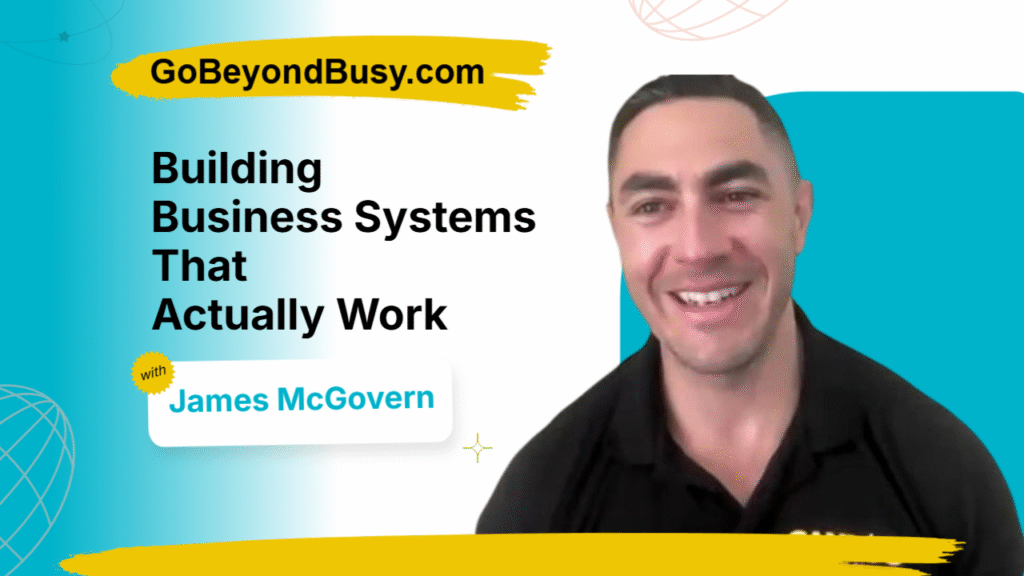
In this episode of Go Beyond Busy, Christine Abela speaks with James McGovern, founder of Candoo Property Services, about the lessons he wishes he had learned earlier in business. The conversation centres on systems, clarity, and why progress often stalls when those pieces are missing.
James has been in business for more than twenty years, starting his first venture at 19. His experience spans franchise ownership, franchising at scale, and building service businesses across New Zealand and Australia. Throughout the discussion, one theme keeps returning: structure changes outcomes.
Why being busy is not the same as moving forward
A lot of businesses feel productive without actually progressing. Meetings take place. Conversations happen. Plans are discussed. Yet the following week looks much the same as the one before.
James explains how unfocused meetings create that pattern. Time gets spent talking, but clear outcomes never land. When actions are not tied back to a longer-term direction, effort spreads thin and momentum fades.
Clarity around outcomes is where things start to shift. Meetings with a defined purpose, a limited agenda, and agreed next steps stop becoming talk sessions and start becoming decision points. Over time, that discipline compounds.
Turning long-term vision into weekly action
Big goals tend to live safely in the future. Ten-year plans and three-year targets often feel impressive but distant. James talks through how those ideas only become useful once they are broken down into much shorter timeframes.
A ninety-day focus provides a bridge between long-term thinking and weekly action. Each week then has a clear role to play. Progress becomes visible. Adjustments become easier. People know what matters now, not just what matters eventually.
This approach also makes it harder to drift. Issues are identified, discussed properly, and resolved with a specific action attached. Attention stays on the problem at hand instead of bouncing between unrelated topics.
Systems as a foundation, not a constraint
Systems sometimes get a bad reputation. They can sound restrictive or impersonal, especially to business owners who value flexibility. James takes a different view.
Well-designed systems remove guesswork. Decisions become simpler. Standards stay consistent. People know what good looks like, even when the owner is not present.
Franchising makes this visible because systems are not optional. Training, compliance, service delivery, and customer experience all depend on repeatable processes. According to James, the same thinking applies whether a business is franchised or independent.
A business that could be franchised, even if it never is, tends to be easier to manage, easier to improve, and easier to step away from when needed.
Franchising, independence, and choosing what fits
The conversation also covers franchising from several angles, including where it works well and where independence can be the better option.
James explains why franchising suits people who want support, structure, and a proven framework. Systems, training, and brand backing reduce risk, especially for those early in their business journey.
Independent operators still have an important place. Experience, capability, and local knowledge can make independence the right choice for some. The key point James makes is that neither path works without discipline. Systems still matter either way.
From a customer perspective, franchising can offer consistency, accountability, and backing that smaller operators may struggle to provide on large or complex jobs. That reassurance often matters more than people expect.
Building businesses that last beyond the owner
One of the strongest ideas in this episode is the difference between buying a job and building an asset. James is clear that many people start businesses without ever creating something that could be sold or stepped away from.
Systems create value beyond the owner. Knowledge gets documented. Processes live outside one person’s head. Teams can operate without constant supervision.
That shift changes how a business feels day to day. Pressure reduces. Decisions become calmer. Growth becomes intentional rather than reactive.
Why this matters if your business feels stuck
This episode is particularly relevant for business owners who feel busy but frustrated. Long hours without progress usually point to structure issues, not motivation problems.
Systems do not need to be complex to be effective. Small changes, applied consistently, often deliver the biggest return over time. James’s experience shows how that thinking develops through years of trial, error, and refinement.
The full conversation goes deeper into these ideas, including how Candoo has structured its services, its franchise model, and its next stage of growth.
Here is how to contact James:
LinkedIn https://www.linkedin.com/in/james-mcgovern-australia/
Company LinkedIn https://www.linkedin.com/company/candoo-crew/
Website https://candoocrew.com
Want to read the transcript?
Introduction to Go Beyond Busy
[00:00:00] Bernard: Welcome to Go Beyond Busy.
In this episode, Christine speaks with James McGovern, founder of Candoo Property Services. James has been in business for more than twenty years and has built and led franchise businesses across New Zealand and Australia.
The conversation focuses on what James wishes he had understood earlier, particularly around systems, structure, and clarity. Topics include why unfocused meetings slow progress, how long-term vision becomes practical weekly action, and the role franchising can play for both business owners and customers.
Meet James McGovern: Founder of Candoo Property Services
Christine Abela: Hi, I am Christine from Go Beyond Busy.
I’m here with James McGovern who runs a cleaning franchise business called Candoo, and he’s in Auckland New Zealand. How are you today, James?
[00:00:46] James McGovern: Good. Thanks Christine. Thanks for having me on.
[00:00:48] Christine Abela: Very good. What have you learned about running a business that you wish you’d known earlier?
Lessons Learned in Business
[00:00:53] James McGovern: Oh. Plenty of things. Plenty of things. I’ve been in business for 20 odd years, since I was 19. And so when you are that young inexperienced, I think you make a lot of mistakes early on in the career.
The Importance of Systems and Structure
But I think if I had to put it down to one thing that I wish that I could have done better earlier it would’ve just been around the systems that I’ve managed and using one, protocol in order to operate the business.
To really clarify that, I guess it’s, we’ve got a really structured rhythm of the meetings that we have in the organization now and how we conduct those meetings and the outcomes that we need from those meetings. And I really think that one difference, that one tweak you make to a business can 10 x your business.
Having a meeting that’s not clear without clear outcomes at the end of it. And just going into the week, you’ve spent two hours talking, so you feel good about that. And you might have talked about a lot, but there’s not real clear outcomes for it. And they’re not aligned with what the actual vision of the company is.
It wastes a lot of time. So I think that’s one thing that I’ve really worked on over the years, and one thing that I think we’ve done pretty well now.
Breaking Down the Vision into Actionable Steps
And we’re just really structured about the vision that we have and then the breaking that down from, a 10 year into a three year, into a 90 day into then week by week.
What do we need to do to get towards that 90 day? And setting clear actionable outcomes every week to get towards there. Discussing the issues that we have, and again, staying on track with that issue rather than going all over the shop and ending up on a different issue. And then coming up with a clear outcome what to do this week to fix that. What to do this week, to get towards that 90 days.
So we’re constantly moving forward rather than staying in the mud. So that’s probably the one thing that I would wish I could have told my 19-year-old self when I went into my first business. But something that I think that I’ve worked on over the years, and we’ve got pretty right now.
[00:02:33] Christine Abela: Very cool. Now, when I introduced you, I said you run a cleaning franchise business, but I see on your shirt that it says Candoo Property Services. So it’s more than just cleaning, isn’t it? Tell me about that.
Expanding Beyond Cleaning: Candoo Property Services
[00:02:45] James McGovern: It is. So we met through BNI and BNI is per industry. So you’ve only one got one person per industry. So I represent, Candoo Cleaning in BNI Metro and but yeah, Candoo is a whole lot more than that. So we do a full range of property services and that is our vision, is actually to be a full property service suite, to be able to provide a one-stop shop solution as a head company.
And then to provide leads that come from that to our franchisees that run their independent businesses. So then you’ll have a cleaning franchisee. You’ve got a lawn and garden franchisee. You’ve got, heating and ventilation, pest control, test and tag. So there’s a lot of different options there for the client to be able to go to one person and say, “Hey, we require these services.” They get to deal with one account manager for commercial, one invoice once a month for commercial. But then we’ve got specialty service providers that come and actually do the work. And the benefit for a franchisee then is we’re, positioning ourselves in a blue ocean rather than a red ocean where you’ve got all your competitors.
So cleaning is hyper competitive, commercial cleaning in particular. Instead of us walking into a venue or premise and just saying, “Hey can we please quote you for cleaning?” We position ourselves as a solution provider that we’ll be able to look after multiple services for them, be able to actually advise them on what services are required.
Some for compliance, some just to make the place look a bit nicer. But then we can actually advise on that and provide the solution, as opposed to just trying to sell them one product, which is the benefit for our franchisees.
The Franchise Model: Benefits and Challenges
[00:04:11] Christine Abela: So you’re talking about franchisees.
Did you always run a franchise type of a model?
[00:04:17] James McGovern: Yeah. So I mentioned I got into business when I was 19. I was probably an entrepreneur much before that. I was used to breed birds when I was a teenager and sell them to pet shops. So I was in wholesale and distribution and livestock. But then when I was 19, I actually bought a Red Rooster franchise in Australia.
You said you lived in Australia for a while, so probably know that brand. Which is like a barbecue chicken drive through restaurant. And so I bought that when I was 19 years old. It was losing a lot of money but I’d worked at Red Rooster since I was 14 years old, so I already had five years experience there.
Thought I knew everything, because I had five years experience there. But obviously owning a business is very different to being a kitchen hand or a cashier or a manager. But I suppose I was conditioned to franchising from the age of 14. And so I believed in it. I believed in the systems and I took those and I’d seen managers fail because they didn’t use the systems.
And so I thought that I’d be a successful franchisee by using the systems. And although there was a lot of things to learn about managing a business, I used the systems and that’s why I’m a big believer in franchising. Red Rooster actually made me their trainer for incoming franchisees.
And not to say that I agreed with everything that the franchisor did. But then you have those conversations and communicate that and good franchisors then manage up. So they, listen to their franchisees and take on advice and collaborate. Not that it’s always gonna go either party’s way.
That’s where it’s a really, a relationship and a marriage is what the is the cliche in the industry. So that was, my entry into franchising. And then I’ve been a franchisor of several concepts since then. So whether this was gonna be a franchise from the beginning, I’d say so, yes.
I’ve just got a passion for franchising. I think that it’s a really good model and it serves two different purposes for a franchisor and a franchisee. So franchising really is complimentary. You get to a franchisor that’s strong in certain aspects or should be strong in certain aspects of business. And then you’ve got a franchisee who compliments that with other aspects of the business. And a lot of times that’s the day-to-day operations, obviously.
And the local community and the local area marketing. So I’m a big fan of tying those two together. I’m a big fan of it being somebody’s first foray into business as well and learning from a franchise to potentially then go and be an independent down the track. That’s what I did.
I was a franchisee with Red Rooster for five years before I went out as an independent. And you see a lot of franchise models or franchisors have actually previously been franchisees for that reason. You learn the tools of the trade, you learn business, you learn systems. And I think it’s a really good MBA, into business. A lot of business books talk about systems. I think, even you as a business coach a lot of it is just about systems. What’s one of the most well-known books, the E-Myth Revisited. And it talks about franchising. My mentor in Australia, Doug Downer he’s got a book called Franchise Ready, which means you don’t have to be a franchisor, but you should always be ready to franchise. So if you sold your business, it should be able to be franchised through systems. And I think that’s the really cool thing about a franchise business.
You develop all the systems that’s required to run the business. If you follow those systems, you should be successful. Should be. It’s never guaranteed. Success is never guaranteed, but you’ve got a lot better chance, especially if you’re new into business. Yeah, from day one it was gonna be a franchise model.
We thought we were just gonna get people leads was the main thing that we thought franchisees wanted at the time. And then we had a good business operating system. So our onboarding and our learning management software to teach people how to operate a business for this franchise the lawn and garden and the cleaning.
But we quickly found out in the New Zealand market, franchise landscape is a lot different to Australia. I’m from Australia, if you can’t tell from my accent. And and so we had to actually remodel what our franchise looked like pretty early on because here franchising is a lot more conditioned to the franchisor doing more.
So franchisors in New Zealand, they don’t just provide leads. They actually generate a lot of the work and effectively subcontract the franchisee. We do that now, but we also simultaneously teach the franchisee how to operate a real business. So we’ll give them that security of the contracts that we can provide them, but then on top of that, we teach them how to go out and get their own work and build a real business and build equity in a business rather than effectively just being a subcontractor or, on the verge of just buying yourself a job. But some people want that, that’s all. They just wanna make a little bit of extra money and they’ll just buy themselves a job to work in the evenings as a cleaner or something like that. But what I’m really passionate about and what our business is really passionate about is utilizing franchising to actually teach people how to build a business and build themselves an asset that they can sell down the track, and then potentially go and be independent later.
[00:09:02] Christine Abela: You’ve talked a lot about the benefits for a business owner in working with a franchise rather than going independent. But I’m gonna put you on the spot a little bit here. What would be the advantage for a customer who wants their house cleaned or their lawn mode and actually going with a franchise business rather than going with an independent person?
[00:09:23] James McGovern: Yeah, that’s an interesting one. There’s several benefits and I’m not a zealot about franchising. I think that you’ve got really good independent businesses out there and I really respect other franchisors. There’s other franchise systems that I really respect as well. As much as I’d love to say we’re the best at everything I think that it’s specific to what you’re looking at. And I think there’s some really good independent operators out there that don’t need a franchise. But as a franchise I think the first thing is you’re not getting cowboys.
You’re getting somebody who’s been vetted by the franchisor. So we’ve done our MOJ checks criminal checks. To be compliant as a franchisee they’ve gotta be insured. And and we go through training with them. So you know that it’s somebody who’s gonna be competent at what they do.
You’re gonna get a consistent level of service. The next benefit I would say is then you’ve got the backing. Especially if it’s a big job, we offer what we call a 200% confidence guarantee. Meaning if we don’t do the job we will come back and fix it. If we definitely don’t do it right, we will give you a a refund for that day or not charge you for that day’s work.
And then we’ll also give you a credit for the same amount. So it’s a 200% guarantee. And it’s backed by a national company. So if you’ve got a complaint, if you’ve got a smaller operator that might not have the capital behind them to be able to honor a guarantee like that. Particularly for bigger jobs, like we do things like end of build cleans, that might be up to $30,000 for one job.
So if you don’t have a bigger company behind that to guarantee that, there’s a bit of risk there for the client, for the customer. That’s another thing. And then the third benefit that I would say is again is that all in one solution that we’re offering. So that’s not specific to franchise, but franchising makes that easier for us because we can get specialists in a field.
So we can have the different specialist technicians that will come out and actually perform the service. But you’re just dealing with one head office. So that’s probably the three major benefits that I would say of picking a franchise over an independent, but again, I’m not a zealot.
I understand there’s some really good independent operators out there. I actually love working with independent operators and we subcontract if we don’t have a franchisee for a service we subcontract to independents. We talked about what makes a good franchisee, and I think that’s really important to note that franchising isn’t for everyone.
And independent is really a good way to go if you’ve got the know-how already and if you’ve built up the skills and if you’ve got all that. Yeah, if you’re a potential client look at both. Do your due diligence. ‘Cause there’s pros and cons.
International Expansion and Future Plans
[00:11:46] Christine Abela: You are mainly based in New Zealand. Is that the only place where you operate?
[00:11:51] James McGovern: Good question. So we’ve already got some presence in Australia not as a franchise model. So we’re servicing some cleaning contracts in AU and the really exciting thing for us as a business is actually an app that we’re developing at the moment. And that app is gonna be good for our franchisees in New Zealand.
But it then allows us to go into new markets such as Australia or the US or Canada, UK, and actually heat map where the interest is. So in that app we’re allowing independents to actually join our network, not have to pay a franchise fee.
And effectively we’re a lead aggregator. So when we have a client that wants 10 different services we can then have all of these independents who we’ve done the due diligence for, we’ve vetted them, make sure that they’ve got their criminal checks, they’re insured, that they’ve got the certificates that they require.
And and then we can offer the full suite, this full service through this app as a commercial product. Or even as a residential, if you just wanted one job done, you can do it through the app. Think of it as an Uber for property services. So we’ll be rolling that out in New Zealand hopefully in February. We’re developing the app overseas. So I’m flying out on Monday to meet with the developers and I think we should be ready to roll that in February.
But the purpose, or a big part of the intention of that is to then be able to heat map other markets. So we can go into the Australian market and we can promote that app, we can recruit contractors, we can promote it to prospective clients and then get some BDMs going and doing the commercial aspect of that. And that will then tell us, Hey, we’ve actually got a bunch of clients here that want cleaning done or we’ve got a bunch of clients that want here, fire safety. Let’s talk to these operators to see if they would be interested in joining our network as a Candoo franchisee. Otherwise we can recruit a franchisee in that local market. And obviously any new leads that come through the franchisee is gonna be first in line to receive those leads.
So it becomes like a first right of refusal scenario. That’s the model we’ve got at the moment. But long answer to a simple question, yes, international growth is next on the agenda. But it’s all step by step for us to be honest.
Conclusion and Contact Information
[00:13:52] Christine Abela: Wonderful. Thanks very much for talking with me today. I’ll put James’s website details under the video or wherever it is that you are watching this. And I’ll also put a link to where you can get in touch with me for a free business strategy session if that’s what you would like to talk about your business. So thank you very much James.
[00:14:08] James McGovern: Thanks, Christine. Thanks again.
[00:14:09] Bernard: That was Christine Abela in conversation with James McGovern from Candoo Property Services.
You will find a link to James’ website under this episode.
A free business strategy session with Christine is available to listeners who would like to discuss their business challenges and opportunities. Details for booking that session are also available wherever this episode is watched or listened to.
25 January 2026 · Season 3 : Season 3 · Episode 4
14 Min, 47 Sec · By Christine Abela
Christine Abela speaks with James McGovern about building business systems that create clarity, improve focus, and support long-term growth through structure and disciplined execution.