There is a big difference between being busy and being productive.
Many business owners I work with are flat out. The phone is ringing. The inbox is full. Staff are moving. Jobs are getting done.
And yet, profit feels tighter than it should. Margins feel squeezed. The owner is exhausted.
That is where Lean Process Improvement comes in.
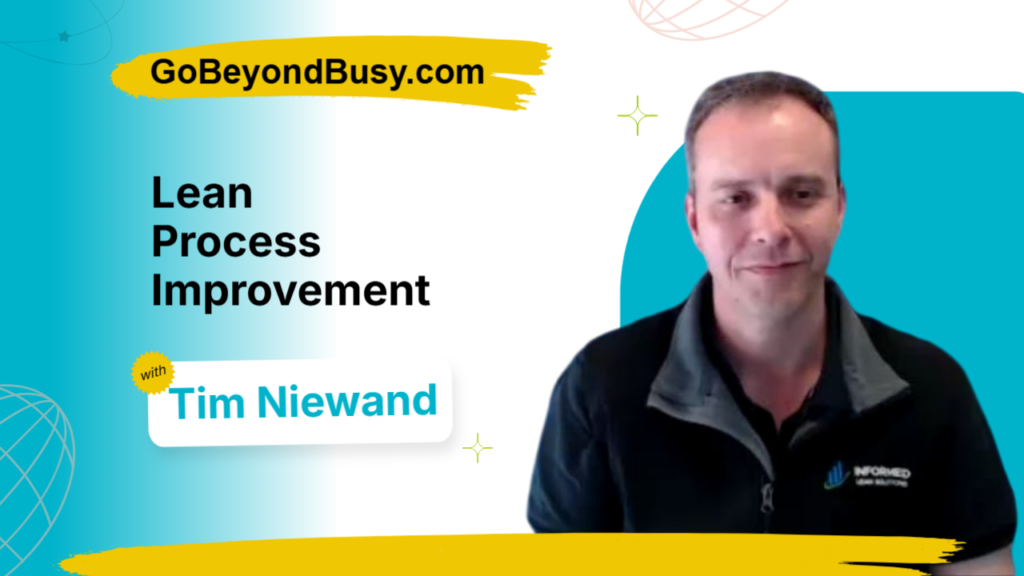
In this episode of Go Beyond Busy, I spoke with Tim Niewand from Informed Lean Solutions ( https://informedleansolutions.com.au ) in Melbourne about identifying and eliminating waste inside a business. What struck me most was not just the framework he uses, but how relevant it is to everyday businesses, not just large manufacturers.
Speaking the Language of the Customer
Tim shared something that resonated strongly with me as a consultant.
When he first launched his business, he described his service as helping clients “eliminate waste”. The problem? People thought he was a rubbish removal company.
It took multiple revisions of his capability statement to realise that what made sense to him did not automatically make sense to his clients.
That lesson alone is worth paying attention to.
Lean Process Improvement is not just about operational systems. It is about clarity. It is about understanding how your clients think, how your team works, and how value is actually created inside your business.
What Is Lean Process Improvement?
Lean originated with the Toyota Production System, but it is no longer limited to manufacturing.
At its core, Lean Process Improvement looks at how work flows through a business and asks one simple question:
Where is the waste?
Tim explained the TIMWOODS framework, which identifies eight common types of waste inside any process:
Transportation – unnecessary movement of goods or information
Inventory – too much or too little stock or work in progress
Motion – people physically moving more than required
Waiting – time lost between steps, approvals or responses
Overproduction – doing more than is needed
Overprocessing – adding work that does not add value
Defects – errors and rework
Skills – unused talent within your team
If you are running a trades business, a retail store, a professional service firm or even a multi-site operation, you will recognise at least three of those immediately.
The interesting one for many owners is “Skills”. Unused talent is a hidden cost. When staff are not empowered, trained or positioned correctly, productivity drops and frustration rises.
That is not just an operational issue. It becomes a leadership issue.
Lean Is Not Just for Big Corporates
One of the myths around Lean Process Improvement is that it only works for large organisations.
Tim works with small businesses under $10 million turnover as well as larger operations with hundreds of staff. The principles are the same. The scale changes, but the thinking does not.
Processes exist in every business.
Quoting. Invoicing. Job scheduling. Customer onboarding. Stock ordering. Staff communication.
Where there is a repeatable action, there is a process. Where there is a process, there is the possibility of waste.
And waste is not just money. It is time, energy and mental load.
Kaizen – Change for the Better
We also discussed Kaizen, the concept of continuous improvement.
Kaizen is not about massive overnight change. It is about steady, structured improvement over time. Small refinements. Clear measures. Adjustments based on data rather than emotion.
That aligns closely with how I work inside the Business Success Programme. Before making changes, we look at the current state. We establish measures. We identify root causes rather than symptoms.
Many owners try to fix problems by adding more activity. More marketing. More hours. More staff.
Often the real opportunity is simplifying what already exists.
Coaching Versus Consulting
Tim described his work as walking alongside leaders rather than delivering a “silver bullet”. That distinction matters.
Lean Process Improvement done properly is not about an external expert arriving with a ready-made solution. It is about facilitating clarity so the business owner and team can see the process differently.
That is where long-term change happens.
When people are involved in diagnosing the issue and shaping the solution, implementation becomes far easier.
Where This Fits for You
If you are turning over between $1 million and $10 million and feeling stretched, there is a strong chance that waste exists somewhere in your systems.
It might be:
Quotes taking too long to turn into approved jobs
Stock being over-ordered
Staff waiting on unclear decisions
Rework caused by poor handovers
You being the bottleneck
Lean Process Improvement is not about perfection. It is about awareness and structure.
In my work with clients across South Canterbury and beyond, we often uncover simple changes that create disproportionate results. A clearer workflow. A refined reporting structure. A small automation. A reallocated responsibility.
None of it is dramatic. All of it compounds.
If this episode has prompted you to look at your business differently, that is a good sign.
The video is above and the full transcript is below. Watch it with one question in mind:
Where is the waste hiding in my business?
If you would like help answering that question in a structured way, you can book a free Business Strategy Session.
Clarity first. Improvement second. Growth follows.
Want to read the transcript?
Welcome and Setup
[00:00:00] Bernard: Welcome to Go Beyond Busy, the podcast for business owners who want to move from constant firefighting to calm, structured growth.
[00:00:08] In this episode, Christine Abela speaks with Tim Niewand from Informed Lean Solutions in Melbourne, Australia.
[00:00:16] Tim shares what he learned the hard way in his first year of business: if you explain what you do in your language instead of your client’s language, it simply will not land. He talks about refining his messaging, adjusting his capability statement multiple times, and learning how customers actually think.
[00:00:35] You will also hear a clear explanation of Lean thinking, the TIMWOODS framework for identifying waste in any process, and how continuous improvement, or Kaizen, applies far beyond manufacturing.
[00:00:48] If you have ever felt that your business could run more smoothly but you are not sure where to start, this conversation will give you practical insight and a new way to look at your processes.
[00:01:01] Here is Christine with Tim Niewand.
[00:01:04] Christine Abela: Hi, I am Christine from Go Beyond Busy.
[00:01:06] I’m here with Tim Niewand, who is from Informed Lean Solutions, and he’s in Melbourne, Australia. How are you today, Tim?
[00:01:13] Tim Niewand: I’m good, Christine. Thanks for having me. How are you today?
Big Lesson on Messaging
[00:01:15] Christine Abela: Very good, thank you. So tell me, what’s something that you’ve learned about running a business that you wish you’d known earlier?
[00:01:22] Tim Niewand: One of the big things I’d say that I’ve learned when running my own business is how my clients think. And I’m gonna unpack that a little bit for you because I think that’s really important when it comes to messaging, to marketing, to capability statements, and even what your elevator pitch is.
[00:01:41] What I mean is that when you can explain what you do in words that the customer uses, then it resonates very strongly with them. So I’ve only started out in my business since October last year, and I’ve recently counted up that since then, I’ve updated my capability statement about 10 times in 12 months, and that’s quite frequent. But I’d also suggest that as a startup that’s probably quite normal as well.
[00:02:09] What I was going through during that time was actually adjusting the wording and adjusting my offerings, to make sure that it actually resonated with the customer.
[00:02:21] For instance, one of the key things that I offer in my business is process improvement. And I use the Toyota production system methodology called Lean to help clients with their process improvements. And so what we are doing there is looking for reduction of waste. So I started out initially on my website saying, “Eliminate your waste”. And everyone thought I was a waste disposal company. I would come and bring the dump truck or even worse pump out their septic systems. And that was definitely not the case. So I had to learn how customers would think about this without using my own language, but using theirs.
Lean Explained Simply
[00:03:02] Christine Abela: Tell me more about Lean. What does that mean?
[00:03:05] Tim Niewand: So Lean is a term that came from Toyota originally. And it’s how they run their businesses and it’s this continual pursuit of the elimination of waste. And when we’re talking about waste, we are talking more about process waste. How do we streamline the processes that people work with, and how do we actually see some of the different wastes?
TIMWOODS Waste Framework
[00:03:30] When I talk to people about wastes, there are eight common core wastes that you can look at processes with to actually identify the wastes.
[00:03:42] There is an acronym for that called TIMWOODS.
[00:03:45] The first letter in that acronym stands for Transportation. So it’s the waste of transporting product or goods or information from one place to another.
[00:03:56] The second one is Inventory. Having too much or not enough of something to work on, for instance. If you’ve got too much inventory, you have to store it, you have to manage it, and it could potentially go off depending on the industry that you’re working in. If you don’t have enough inventory, you might be sitting around and waiting.
[00:04:13] The M in TIMWOODS is Motion waste, where people are physically moving from one place to another.
[00:04:19] The W stands for Waiting time, and email is a classic example of that. When you hit the send button, you don’t get an instant reply. You have to wait till someone checks it, and then reads that email before you get a reply.
[00:04:33] There are two O’S in the TIMWOODS. One is Overproduction and the other is Overprocessing. Overproduction is making more than you need to. Overprocessing is doing more work than what you need to and what your customer needs you to do.
[00:04:49] The D on the end stands for defects, and that’s about having poor quality workmanship or any time where there needs to be rework done. Whether that be you haven’t got the requirements right or whether there’s been a mistake in some work somewhere.
[00:05:05] And then lastly, the S in TIMWOODS stands for Skills or talent of people, and especially unused skills and talent of people. It’s a hidden waste that not many people think about. But when you can tap into it, you can see amazing results.
Lean Beyond Manufacturing
[00:05:21] Christine Abela: It sounds like this is really well suited to a manufacturing environment, but could it be used for a plumber or a retailer or some other environment as well?
[00:05:31] Tim Niewand: It absolutely can be used in any environment, Christine. It originally did come from manufacturing, but one of the things that Toyota and others, such as the Danaher Corporation have done is pick that out of manufacturing and put it into an office environment or put it into other environments too.
[00:05:49] Ultimately, what we are looking at here is anytime where there’s a process, where there’s value that’s added to that process, then you can use this to see with a new set of glasses, you can use this to see the process for what it truly is.
Kaizen Continuous Improvement
[00:06:06] Christine Abela: So this is sounding a little bit like Kaizen. I’m not sure if I’m pronouncing that the Japanese term. Is that something similar?
[00:06:13] Tim Niewand: Lean has a core concept of Kaizen, and you’re you’re exactly right. Kaizen is a key part of that. And Kaizen is broken up into two parts, two characters, the Kai and the Zen. And the Kai is meaning change and Zen for the better. And when you combine the two you get change for the better or this whole concept of continuous improvement. And so Kaizen and Lean go together to provide this concept of continuous improvement. So you’re spot on, Christine.
How Tim Helps Clients
[00:06:45] Christine Abela: How does Informed Lean Solutions help a client? What does your process look like?
[00:06:51] Tim Niewand: So we offer four key things for our clients. The first thing that we offer is business coaching. The second thing we offer is operational excellence. The third thing are some growth strategies. And the fourth thing that we offer is layout optimization.
[00:07:08] Now, throughout all of those four things that we offer we help with our clients to analyze their current state, to identify where the issues are that they need assistance with. And sometimes clients won’t know what their issues are, so we have to actually help them flesh that out.
[00:07:27] We’ll establish some measures so that we can actually use data to determine what are the key issues and what are not. And then we’ll actually follow a systematic process of getting to the solution using the Five Whys and root cause methodology to actually assist clients across the way. And we’re applying Lean throughout all of those four core areas of our business.
Remote Work and Client Fit
[00:07:54] Christine Abela: Can you work with people who aren’t in Melbourne?
[00:07:57] Tim Niewand: So I have some clients who, believe it or not, Christine, are based in New Zealand and one in Fiji. Yes, definitely can work across borders.
[00:08:06] Before I went into business, I was doing this for a profession for global organizations and was on calls into Singapore, india, Middle East, into Africa as well as into the Americas. And we were working remotely while mapping out processes and driving process improvement. The technology that we have these days with the internet and various other tool sets are very helpful for working across borders.
[00:08:39] Christine Abela: What sort of size of business do you normally work with?
[00:08:42] Tim Niewand: So I currently have segmented it into two parts. So in the coaching side of my business, I’m working with businesses that are $10 million or less, and typically 10 staff or less as well. But in that sort of range where I’m coaching the leaders of the business and also some of the selected senior leaders.
[00:09:05] But then for the operational excellence side of the business, that goes right up to two to four hundred staff, even quite large businesses. Usually in those large businesses there’s areas where there is process improvement that’s required and we target in on specific key areas.
Kaizen Events in Practice
[00:09:24] And, picking that out. What do we do with those? We actually run what we call Kaizen events, Christine. And you touched on Kaizen before as a mindset and a philosophy of continuous improvement. When we run a Kaizen event, we actually put multiple people together from different stakeholder groups. and you consider it like a workshop. But the key difference is we are making change before we finish.
[00:09:50] So we are focused on eliminating waste on a particular process, and walking out with a changed process during that whole time.
Coaching vs Consulting
[00:10:02] Christine Abela: I’m known as a business consultant, but there’s a difference between business consulting and business coaching. How do you see that?
[00:10:10] Tim Niewand: Christine, that’s a great question. The way I see coaching is that I’m there walking alongside the leader and helping them in the moment play by play, working out what it is that they need to do and offering them actionable strategies to move forward from where they are.
[00:10:31] So I think that there’s probably some areas there where we can compliment each other perhaps in what we do as well, because process improvement is very much about working on the business. And improving the way how the business actually works.
[00:10:46] It’s a roll up your sleeve hands-on type approach that helps people move forward with what they do. I don’t come in with a silver bullet and tell them what to do, but I’ll guide them through the process. They will come up with the answers. And then they’re empowered to implement it as well. I would consider myself helping facilitate them through the various steps involved on that change management journey so that they can improve their business.
Wrap Up and Next Steps
[00:11:17] Christine Abela: Thanks for joining me today, Tim. If anybody would like to have a Business Strategy Session with me for free, then get in touch. I can be contacted through GoBeyondBusy.com.
[00:11:26] I’ll also put Tim’s website details underneath wherever it is you are watching this podcast. So thank you very much, Tim.
[00:11:33] Tim Niewand: Thank you Christine. It’s been a pleasure to be with you today and I really hope that we’ve been able to shed some light on Informed Lean Solutions and process waste for some of your listeners.
Final Takeaways and Links
[00:11:44] Christine Abela: Thank you very much.
[00:11:45] Bernard: If this conversation with Tim has prompted you to look at your own processes differently, there may be opportunities sitting right under your nose.
[00:11:55] Christine offers a free Business Strategy Session for business owners who want clarity around growth, systems and working on the business rather than constantly in it.
[00:12:06] You can book your session at GoBeyondBusy.com.
[00:12:09] Tim’s contact details are listed below the video so you can connect with him directly.
[00:12:16] Thank you for listening to Go Beyond Busy.

1 March 2026 · Season 3 : Season 3 · Episode 9
12 Min, 30 Sec · By Christine Abela
Lean Process Improvement helps business owners eliminate hidden waste, streamline processes and improve profitability without adding more hours.