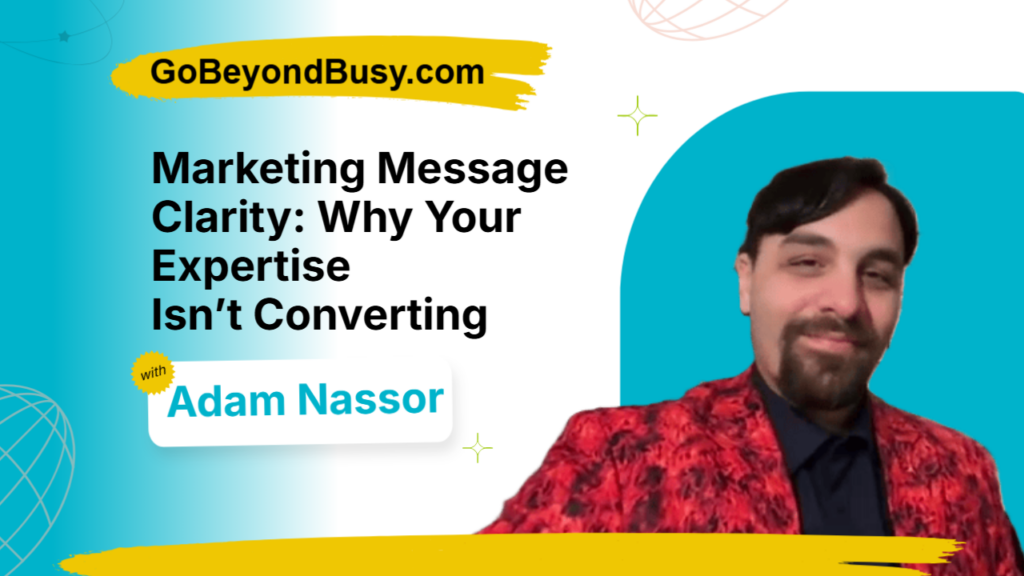
Some business owners are brilliant at what they do, yet still struggle to attract the right clients. It is not always because their service is weak. Quite often, the real issue is marketing message clarity.
That was one of the strongest themes in my conversation with Adam Nassor on Go Beyond Busy. Adam works with experts who know their craft inside out, but find it hard to explain their value in a way that makes sense to the people they want to help.
It is a common problem, especially for small business owners who have spent years becoming highly skilled in their trade or profession. Once you know something deeply, it becomes harder to step back and explain it simply. You stop hearing your own jargon. You forget what it feels like to be new to the subject. You talk like an expert, while your potential client is still trying to work out the basics.
Why marketing message clarity matters so much
If your marketing message is unclear, people do not know whether you are right for them. They may visit your website, read your social posts, or hear you describe your service, and still walk away unsure about what you actually do.
That uncertainty costs business owners more than they realise. It affects enquiries, conversions, referrals, and trust. A person who does not quickly understand your offer is unlikely to keep reading, let alone take the next step.
Adam described this as a problem many experts face. They are excellent at helping clients once those clients come on board, but the journey from stranger to buyer is a different matter. The fact that you are good at the work does not automatically mean your message will land well with the market.
That is where marketing message clarity becomes so useful. When your message is clear, your audience understands what you do, who you help, and why it matters. Good-fit clients recognise themselves in your words. They start to feel that you understand them, which makes it much easier for trust to build.
The curse of knowledge in small business marketing
One of the ideas Adam spoke about was the curse of knowledge. It is a simple concept, but it explains a lot. Once you are highly skilled in something, it becomes hard to picture what life looks like for someone who does not know what you know.
That gap causes all sorts of marketing problems.
A website ends up full of industry language that sounds sensible to the business owner but means very little to a potential customer. Social media posts focus on technical details instead of real-life benefits. Service descriptions become vague, overblown, or cluttered with terms that sound impressive but say very little.
None of this usually happens because the business owner is careless. Quite the opposite. It happens because they know too much about the subject and have not translated that knowledge into everyday language.
That is one reason why an outside perspective can be so helpful. Someone removed from the day-to-day work can often spot the gaps more quickly. They can hear where the message gets muddy, where the wording becomes too inward-looking, and where the business is assuming too much knowledge from the reader.
Why good marketing starts with research
Another point Adam made was that research should come first. That might sound obvious, but many businesses skip it. They assume that because they already serve clients in a certain space, they automatically understand how those people think before they buy.
Those are not always the same thing.
The people who already work with you have already crossed the line. They have already been persuaded. They have already decided to trust you. The people reading your website for the first time are in a different place. They are still weighing things up. They may be unsure, sceptical, confused, or comparing you to other options.
A clear message needs to meet people where they are at that earlier stage.
That means asking better questions. What are they worried about? What are they trying to avoid? What would make them hesitate? What words would they use to describe the problem? What are they hoping life or work will feel like after the problem is solved?
When you know the answers to those questions, your copy becomes far more useful. It stops sounding like a brochure and starts sounding like a conversation.
How AI can help without taking over
One of the parts of the discussion I found especially interesting was Adam’s use of AI. He was very clear that AI is not doing the thinking for him. Instead, it speeds up a process he had already developed and used long before these tools became popular.
That is a sensible way to use AI in marketing. It can save time. It can organise information. It can help test angles and tighten language. What it should not do is replace judgement.
Used well, AI can help a business owner or consultant get to better answers faster. Used badly, it can fill a website with generic wording that sounds polished at first glance but feels oddly empty. We have all seen copy like that. It ticks the usual marketing boxes, but it does not sound like a real person and it does not build much trust.
That is why clarity still matters so much. Whether you use AI or not, the message needs to sound human, specific, and grounded in the real concerns of your audience.
Story matters more than many business owners realise
Another idea Adam raised was the role of story in copy. This is especially relevant for service businesses where trust plays a big part in the buying decision.
People do not only want to know what you do. They also want some sense of who you are, why you care, and whether you understand the kind of problem they are facing.
That does not mean every page needs your life story. It does mean there should be enough warmth, personality, and context for the reader to feel they are dealing with a real person rather than a generic business template.
For some businesses, that may mean sharing the reason the business started. For others, it may mean using real client examples, honest explanations, or more natural wording that reflects how you actually speak. A strong story helps people connect emotionally, not just logically.
That emotional connection often makes the difference between a website that gets glanced at and a website that gets results.
Why outsourcing earlier can be a smart move
The conversation also touched on something many small business owners wrestle with, which is outsourcing. Adam said one of the biggest lessons he learned was to stop trying to do everything himself and focus more on the work he is best at.
That applies to marketing too. Plenty of business owners spend a lot of time wrestling with copy, websites, social posts, and admin tasks they dislike or avoid. The result is often delay, frustration, and half-finished marketing that never really gets out the door.
There is a point where trying to save money by doing everything yourself starts costing more than it saves. That cost may show up as lost time, slower growth, poor follow-up, inconsistent communication, or simply the stress of carrying too much.
Sometimes the best decision is not to keep pushing through on your own. Sometimes the best decision is to get the right help, clear the bottleneck, and move forward properly.
Signs your message may need work
A few warning signs tend to show up when a business has a marketing message clarity problem.
People often ask what you actually do, even after reading your website
You attract the wrong enquiries, or too many poor-fit leads
Your website sounds polished but does not feel like you
Your social posts get little response because they are too broad or too technical
You know your service helps people, but your marketing is not reflecting that value
If any of those sound familiar, there is a fair chance the issue is not your skill level. The issue may simply be that your message is not doing justice to the quality of your work.
A simple place to start
If you want to improve your marketing message, a good first step is to look at your current website or main sales page and ask one question:
Would a good-fit prospect understand within a few seconds what I do, who I help, and why it matters?
If the answer is no, or even “sort of”, there is room to improve.
Plain language helps. Real examples help. A stronger sense of the client’s problem helps. Clearer wording about outcomes helps. So does removing fluff, jargon, and generic claims that could apply to almost anyone in your field.
Most of all, it helps to stop writing from the viewpoint of the expert and start writing from the viewpoint of the person looking for help.
Final thought
Adam’s episode was a good reminder that strong marketing is not about sounding clever. It is about being understood.
Many small business owners are sitting on a genuinely valuable service, but their message is getting in the way. A clearer message can make the business easier to understand, easier to trust, and easier to buy from.
That is not a minor improvement. In many cases, it changes everything.
Adam can be contacted through https://www.linkedin.com/in/adamnassor/
Want to read the transcript?
Why Clarity Wins
[00:00:00] Bernard: Most business owners aren’t struggling because they’re bad at what they do.
They’re struggling because they can’t explain it clearly.
In this episode, Adam Nassor shares how to fix that.
[00:00:13] Christine Abela: Hi, I am Christine from Go Beyond Busy and I’m here today with Adam Nassor, who is in Vienna, in Austria. How are you today, Adam?
[00:00:21] Adam Nassor: Thank you. I’m absolutely fantastic. How about yourself?
[00:00:24] Christine Abela: Very good, thank you. So I have a question to ask you. What’s something that you’ve learned about running a business that you wish you’d known earlier?
Biggest Business Lesson
[00:00:35] Adam Nassor: That question I have asked myself, I think almost every year since I started having a business. And I would say the most important thing is I stopped trying to be a chameleon I hyperfocused on my core skills. And I wonder every day why I did not outsource the things that I don’t wanna do and can’t do earlier.
Think it’s too expensive? It’s not.
Outsourcing Admin Work
[00:01:01] Christine Abela: So what kinds of things do you outsource in your business?
[00:01:05] Adam Nassor: All of the admin stuff. I have an assistant that is phenomenal because, maybe because of the autism, maybe because of the ADHD, but it is for me, an almost insurmountable task to just open a bunch of letters. Because I have so much things to do, so many meetings to have, so much to teach and stuff like that, that this is just so annoying to me.
So I give it to her and she does all that for me. Or for example, sending invoices and stuff like that. You might think if you’re a business owner, you like sending invoices. Guess what? Without my assistant, nobody would pay for me.
[00:01:42] Christine Abela: Everybody likes getting paid, but very few people actually love physically sending out invoices. Yeah that’s very true. So what kind of a business are you running? Tell me a little bit about your business.
What Adam Actually Does
[00:01:54] Adam Nassor: Yes. I think the best way is to give you an example. Imagine an expert that is really good at their job. You probably have a few of them in mind. Now some of these experts, the better they are, the harder they struggle to communicate what they do. They are perfect the moment it’s about their expertise, but the moment they try to post about it or to talk about it, 20 minutes are over and you still have no clue what they do. And that is the problem that I mainly fix with them. Adapt the messaging that it really hits home, that it is very clear, their target audience understands the value of it. And there we go.
[00:02:32] Christine Abela: So you are advising people on how to do marketing? Is it online marketing? Offline marketing? What are you doing?
[00:02:39] Adam Nassor: It’s mostly online marketing. Offline, I almost do nothing. And the thing is, I don’t just advise for them, but I also implement it for them. So if I, for example, tell ’em, Hey the copy on your website doesn’t speak to what you do. Then I don’t just tell them that I immediately change it in the same call and they can leave with a perfectly optimized copy again, for example.
Research First Approach
[00:02:59] Christine Abela: Tell me more about that. What sort of methodologies have you got, any secret hints that we can use to implement your ideas?
[00:03:07] Adam Nassor: Gladly. So the first thing that I always say is research first. Because if you think you know your audience because you are good at helping them, that is not true. Just because you’re good at helping them doesn’t mean you understand them because the people that are already with you that you already help, they already have been sold.
But the step from not knowing you to actually wanting to buy from you, that is not the same. And I have my own proprietary Sherlock method. I actually built a bot on this as well. If you want, I can share the link to it to your audience. Basically what it does is it analyzes your offer. It then brutally honestly tells you that is good, that is bad, helps you implement and improve it. And then it does a process that I call reverse engineered research.
So instead of saying, oh, I’m looking at the market and see what they want, I go from the product and say, okay, we have a good product now. What kind of a person would buy this? And from there I use actually Sherlock Holmes deduction process, plus a few databases and some other techniques.
But then I deduce the potential broad target audiences, create a bunch of different avatars representing them. And then from these hundreds of avatars, I create a median that has at least 80% in common with all of them. And that’s the person that we market to. And the power of this is you can market very specifically to one person, but at the same time, you hit very broadly because they all have the stuff in common.
So you don’t have to market to a hundred people, but you’re also not too niche.
Organic Marketing Not Ads
[00:04:43] Christine Abela: It sounds like you are using techniques such as using AI to help you to do the analysis. You’re using maybe lookalike audiences using things like Facebook and Google advertising, that kind of thing.
Am I on the right track? Is it this kind of thing that you’re doing?
[00:04:57] Adam Nassor: I do nothing with paid advertising. I’m only on organic marketing. So yes, I learned all that stuff, but I absolutely despise Facebook and I hate it so much. Yeah, it is the worst.
I’m a hundred percent convinced that Mark Zuckerberg is allergic to money and he wants to get rid of it as quickly as humanly possible by making Facebook the worst platform that ever existed on a planet.
So what I do rather is yes, I use AI, but this is a process I did even before AI was a thing. So that process used to take three months and cost 15,000 quid, but now it is something I can do in half an hour with my client and costs significantly less.
Basically I taught ChatGPT, I made my own bot inside of it, my own custom GPT, how to do the process. And from then I pilot the whole thing. My client sees that I use it live together. I get the feedback of my client and we get very specific and very deep. And so to me, it’s like a speed-up tool. Like it does not do the work for me, but it speeds up the process that would be tedious and long, like writing it all down, for example.
Deep Psychographics Copy
[00:06:02] Christine Abela: So once you’ve identified the audience, you can then help them with the right copy. Tell me more about that.
[00:06:10] Adam Nassor: So once I have the right audience, I go hardcore with psychographics and demographics. Like they get 270 different data points on their psychographics. For example, what keeps them up at night? What is their family like? What are their values about family? How do they think about religion? All of these different things that are important, right?
And what are the hidden objections they would never tell you? What are the true trigger points they would never admit? All of that.
And based on that, I weave it into the copy, I build the messages on it. And sometimes I realize I just talked to an expert today. She is great at what she does. She loves her job, but because she didn’t know how to write a copy, she let ChatGPT handle it.
And she has a very, say, intimate business. Something that really goes very deep and you need to have deep trust to work with her. But nowhere on her website is any of that mentioned. Nothing about her. Nothing about her story. Why she cares, what makes her. It all sounds extremely HR coded marketing speak that could not be more distant.
And she was very surprised when I told her that because she didn’t know. And so for these people, I implement my forever story system. That’s a storytelling system that I developed that is based on how our unconscious mind records our life in story form. And that is something that makes storytelling multiple times more effective than the classical hero’s journey.
Hypnosis In Messaging
[00:07:39] Christine Abela: When we were talking before this, you told me that you have been involved with hypnosis for quite some time. So how do you use hypnosis techniques in your copy?
[00:07:50] Adam Nassor: Ooh, that’s a very good question. So as the background for this hypnosis, to me, is not a technique but a language.
I’ve been doing this since I was 12, and once you understand that as a language, you realize that the unconscious mind has a very specific way of communicating and a very specific way of responding to communication. So when you are able to implement that, it works.
For example, the unconscious mind at the same time interprets every possible meaning of a sentence. So when I say I love you, can say I love you, which is a completely different meaning than when I say I love you, right? And so all of these potential interpretations are posted at the same time.
So when I have certain ambiguities in a sentence that can be interpreted in multiple ways, maybe even phonetically, then the unconscious mind takes a message.
Or for example, bolding is a very interesting thing. When you bold, like we have a sentence like, this will not make you a millionaire overnight, and you bold, this will make you a millionaire overnight, right?
For example. Then you have a completely different storyline. Of course, that was just an example. I wouldn’t say you should do that, of course, right? But these are ways of communicating on a deeper level.
But most importantly, the unconscious mind always responds to emotions, to storylines and to imagination, metaphors and stuff. So instead of saying my comprehensive solution helps you engineer different processes to implement better changes inside your business, right? You could say, instead of seeing a burnout team every single day and wondering when they will quit, this will bring the spark back that made you as successful as you are today. Same thing different expression.
Teaching The Thinking
[00:09:46] Christine Abela: Very good. So you help your clients to, to do this themselves, or do you write the copy for them?
[00:09:55] Adam Nassor: I write it for them. But if they want me to, then they can put their employees into my program, and then I actually also write it for their employees, which is great for them. But I also teach them, of course, how to think behind that because I’m 100% convinced you can’t teach people anything until they understand the thinking of how it’s done. That’s why I love the Egregore technique. Have you heard of that before?
[00:10:19] Christine Abela: No. Could you say that again?
[00:10:21] Adam Nassor: Yeah. Egregore.
It is a wonderful technique I learned from my hypnosis mentor, and it has incredible results. It improves the growth of an employee or anybody who learns from you so many times so fast, and it works like this.
If you put the person who knows how to do it in the hot chair and the rest of the team who doesn’t know to do it yet, they don’t ask questions, but they have to guess why the person did what they did. And the person just listens, doesn’t give any feedback, and they have to extrapolate and understand the thinking. And then when they have their thesis and they say yes or no and explain, and this way, the growth is tremendously fast.
[00:11:02] Christine Abela: So how does that apply to marketing and copy?
[00:11:05] Adam Nassor: For example, I noticed that when I taught my clients; before I had a course where I taught it, right? When I taught my clients, this is how it started, this is the formula, and so on and so on. I gave them literally everything. I even made them a bot that can write most of it for them. They still couldn’t get it done. They still did it wrong.
And I was like, am I a bad teacher? Are these people not made for this? What’s the problem here? Is my bot wrong? And I realized, nope. It’s the same thing as if you give somebody with two left hands the world’s best toolkit and say, do that work. It won’t work because the person is not a carpenter. They don’t understand it.
And that’s the same principle. So I teach them the thinking behind what I do. I still do it all for them because most of them say, you know what, I love that I know it now. It helps me the future when I hire somebody, but please do it for me.
Ideal Clients And Scams
[00:11:56] Christine Abela: So who’s your ideal client? A small business owner, anywhere in the world, English speaking world. You have a interesting accent, so perhaps you know another language other than English. Describe your ideal customer.
[00:12:09] Adam Nassor: Yes German and English speaking, no problem. It can also be worldwide. I do most of my work online. My perfect ideal customer yes, is a solopreneur or small medium enterprise that is severely struggling with exactly that.
They are good at what they do, they can’t get it over. Most of them hate writing copy. They don’t know how it’s done. They hate social media. They know they need it, but they have no clue how it’s done and they struggle severely with it.
And most of the time they get ridiculous offers, but because they don’t know, they lose a lot of money. To give you an example one of my best clients got an offer at, now get this, for 45,000 euros down payment of a 70,000 euro program. And now think about this. What do you think she got for paying an agency basically a very good yearly salary?
I will expect that they do the copy and the socials and my website and my design and everything for me.
Nope. They told her to write her copy herself. Then they gave her Facebook templates for ads that were non-compliant, so she got banned. Then they told her to do Facebook group marketing that did nothing because nobody wanted to get in the group. Then they told her to just tell her story every single day, that’s fine. It was not fine because I didn’t tell her how to tell her story. And when she asked Hey guys, I’m doing everything you say, but nothing works. What’s up? The answer was, and I quote, see now you know how it doesn’t work. Isn’t that also valuable?
And when she didn’t tell them like, guys, I’m paying you a lot of money to help me avoid that. Doing it wrong, I can do by myself. Then they said you have a bad mindset. We gotta kick you out. But thanks for the money.
[00:13:55] Christine Abela: Ouch.
[00:13:55] Adam Nassor: And because people don’t know what is good and what is bad, they fall for these charlatans. And so I see it a little bit as my mission too, to offset this, to flood the market with experts that know what they’re talking about. They are great at what they do because usually the bad charlatans, they have good marketing.
But if the experts have good marketing too, there’s a grand equalizer happening and then skill counts. So I wanna offset that a little bit with what I do and help them out to give them a leg up and a little bit of a speed boost.
If they know what to look out for, they’re a little bit more safe. Another client of mine actually profited a lot of that. It was also the reason why he wanted to work with me because he wasn’t super sure yet.
Because of course it is an investment. It’s not a lot compared, but it was still, he said he got another offer and he’s not sure. I said, you know what? Here’s my promise. show me every offer that you get. And if it’s a good offer, I will tell you to go with them.
Basically I told him and he sent me these offers and I was like, I would love to tell you that’s a good offer, but it’s not. They asked him to pay 1500 bucks a month on top of a 50% commission. How is he gonna make money? This is never gonna work. And also for just posting three times a week. This is ridiculous.
Curse Of Knowledge
[00:15:17] Christine Abela: You’ve probably worked with quite a few small businesses and a lot of these people will be experts in their field, but what’s the biggest mistake that they do in their marketing?
[00:15:26] Adam Nassor: Hands down, they absolutely fail because of the curse of knowledge. The curse of knowledge says that if you are very good at something, you can’t imagine anymore how it is to not have your knowledge. And because of that, you fail to speak the language of the people who want to help.
You speak as an expert. They don’t understand you. You can’t relate to their problems anymore because they don’t have your skillset and you don’t have the problem. And this mismatch in communication leads to wrong offer creation, wrong messaging, wrong marketing strategy, wrong social media presence. And it completely destroys the credibility. Because a true expert is not known by how much they know, but by how simple they can explain it to somebody who doesn’t.
Wrap Up And Links
[00:16:16] Christine Abela: Very good. Thank you. It’s been lovely talking to you. I’ll put some links underneath this video or wherever it is that you are watching or listening to this so that you can get in touch with Adam. And if anybody would like to have a chat with me about their business, i’m offering a free business strategy session to small business owners. Thank you very much.
[00:16:34] Bernard: If this has you thinking about your own marketing, Adam’s links are in the notes below the video so you can connect with him directly. And if you’d like a second set of eyes on your business, you can book a free Business Strategy Session with Christine at GoBeyondBusy.com.

29 March 2026 · Season 3 : Season 3 · Episode 13
17 Min, 3 Sec · By Christine Abela
Marketing message clarity helps experts turn skill into clients. Here’s why clear messaging matters more than expertise alone.