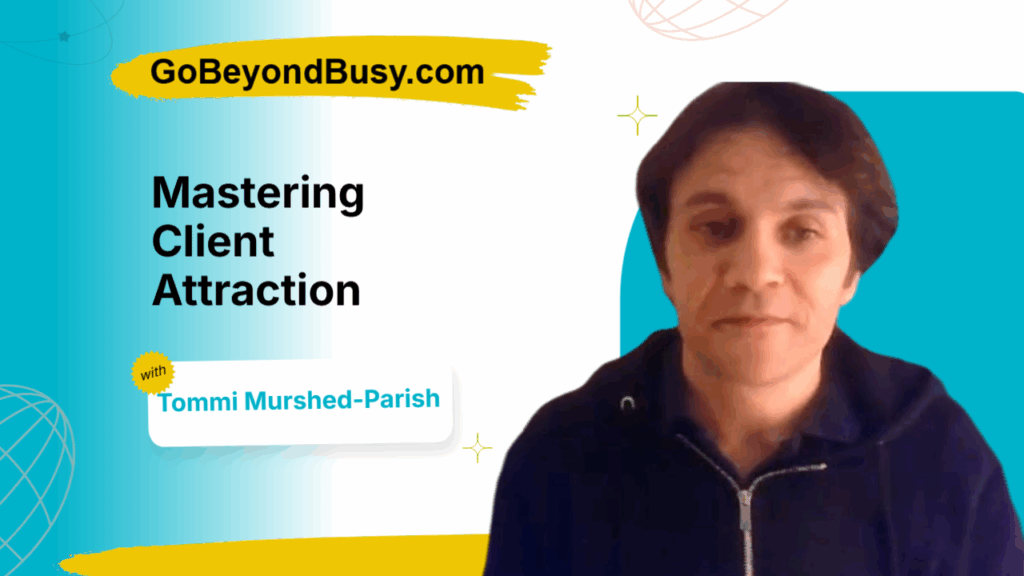
Client attraction is often misunderstood. Many business owners assume it comes from doing more marketing, answering more enquiries, or working harder to convince people to buy. In reality, attraction usually shifts when confidence, clarity, and positioning change.
This episode of Go Beyond Busy looks closely at why client attraction breaks down and what happens when chasing is replaced with certainty.
Christine Abela speaks with Tommi Murshed-Parish, founder of Convert More, Chase Less. His work focuses on helping business owners improve client attraction by using real client stories instead of sales-heavy messaging.
A central idea runs through the conversation. When a business owner appears desperate for work, client attraction weakens. When confidence increases and boundaries become clearer, conversations change and better-fit clients respond.
Tommi can be contacted at https://www.linkedin.com/in/tommi-murshed-parish-conversions-chief/
How client attraction improves when chasing stops
Client attraction is not about ignoring people or acting superior. It is about being clear on value and outcomes, and being comfortable walking away from work that is not a good fit.
Tommi explains how many business owners unknowingly place themselves in an audition role. Over-explaining pricing, justifying decisions, or trying to please everyone reduces client attraction rather than strengthening it.
Confidence shifts that dynamic. Prospective clients sense balance and certainty, even when it is never stated directly.
Choosing clients as part of a client attraction strategy
A strong client attraction approach involves choice.
When a business owner:
- understands who they work best with
- recognises which projects create friction
- accepts that not all work is equal
the quality of enquiries improves.
Client attraction often increases when volume decreases. Better conversations lead to better relationships and more sustainable growth.
Why weak testimonials damage client attraction
Testimonials are often treated as a box to tick, yet many do little to support client attraction.
Tommi explains that most testimonials fail because they focus on praise rather than experience. Clients are asked to promote the business rather than share what changed for them.
Common problems include:
- vague positive statements
- no emotional context
- no clear before-and-after story
These testimonials add surface credibility but rarely influence buying decisions.
Using client stories to strengthen client attraction
Effective client attraction relies on stories that feel real.
Tommi interviews clients in depth about:
- what life or business was like before
- what outcomes changed
- why those outcomes mattered
This approach creates testimonials that feel relatable. Prospective clients recognise themselves in the story, which builds trust early in the decision process.
Where testimonial content supports client attraction
Client attraction improves when testimonials are used beyond a single video.
One interview can support:
- a primary testimonial video
- short clips for social platforms
- written case studies
- proposal and quote support
- referral conversations
- background content for AI tools
When client stories are used this way, they actively support client attraction rather than sitting passively on a website.
Who this client attraction episode is for
This episode is especially relevant for:
- consultants and advisors
- professional service providers
- service-based business owners
- businesses relying on trust and expertise
Any business that feels busy but misaligned will recognise the client attraction challenges discussed.
Want to read the transcript?
Introduction to Go Beyond Busy
[00:00:00] Bernard: Welcome to Go Beyond Busy, the podcast for business owners who want fewer dead ends, better conversations, and more of the right clients.
[00:00:09] Christine Abela is based in New Zealand and works with business owners who are tired of chasing work that never quite fits. Each episode features practical conversations about running a business with clarity, confidence, and better systems.
[00:00:24] In this episode, Christine speaks with Tommi Murshed-Parish from Convert More, Chase Less. Tommi shares why confidence changes how people respond to you, how strong client stories do the selling for you, and why the way testimonials are gathered matters far more than most people think.
[00:00:43] This conversation focuses on choosing your clients rather than auditioning for them, and on using real stories to attract the people you actually want to work with.
Meet Tommi Murshed-Parish
[00:00:54] Christine Abela: Hi. I am Christine from Go Beyond Busy. I’m here today with Tommi Murshed-Parish, who runs a business called Convert More, Chase Less, and he’s in Malta. How are you today, Tommi?
[00:01:05] Tommi Murshed-Parish: I’m in good spirits. Thank you very much, Christine. Thank you for having me.
[00:01:08] Christine Abela: Thank you. Thanks for being here. So tell me, Tommi, what’s something that you’ve learned about running a business that you wish you’d known earlier?
The Power of Confidence in Business
[00:01:15] Tommi Murshed-Parish: So to answer your question, the more I’m willing to walk away, the more people try to call me back, the more we want people to come towards us. The more desperate I seem and the more I was willing to, as a typically Northern English person, I go, I don’t care anymore.
[00:01:34] Get lost in that polite sense. The more people suddenly took an interest.
[00:01:40] Christine Abela: So how were you able to use that in business? How does that translate in practical sense?
[00:01:46] Tommi Murshed-Parish: It’s not as bitter or as mean as it comes across when I first said it. In the past people were treating me like I was auditioning for them, and I was begging for their time. And actually at some point when I went, fine. It doesn’t matter. Sure. Whatever. I’m not saying it was literally like that, but suddenly people seemed keen.
[00:02:04] No, tell me more. It’s a bit like Monty Python and the Life of Brian, where he’s giving a speech, no one’s listening, and suddenly he’s about to walk away and he has an army following him.
[00:02:15] That’s a slight exaggeration of the situation, but. That’s the thing I noticed when I lost interest in trying to get people to, come after us. I was interested in making a sale for sure, but there was a limit to how much I would debase myself to get there.
[00:02:29] And in terms of translating that into business, it just meant I was confident in what I did. I always was. And I didn’t have to make myself feel humiliate. I didn’t have to make myself feel hum. Ah, it’s one of those nights I didn’t have to make myself feel humane. It’s been a long day. I didn’t have to make myself feel humiliated or small in order to get the sale.
[00:02:52] And the difference in people’s attitudes was night and day.
[00:02:56] Christine Abela: So have you been able to translate that into a business for yourself?
[00:03:02] Tommi Murshed-Parish: It’s a philosophy that underpins my business. So it’s not the business itself, but it does govern how I regard selling myself, if selling myself is the right way to put it.
[00:03:15] Christine Abela: Okay, so what does your business do? Convert More, Chase Less. What does it do?
About Convert More, Chase Less
[00:03:20] Tommi Murshed-Parish: I win people’s best clients in under two minutes or less.
[00:03:24] Christine Abela: How do you do that?
Creating High-Converting Testimonials
[00:03:25] Tommi Murshed-Parish: I do that using high-converting video testimonials that are filmed with in-depth interviews with people’s clients. And then I edit those. Take out the good stuff and put it in the right order to press people’s buy buttons as quickly as possible. So people can have the best choice of clients, rather than having to pick from a pool of slave drivers bagging on us, and troublemakers.
[00:03:48] Christine Abela: So how does that look from a practical point of view? Do I have to go to Malta? How does it work?
[00:03:53] Tommi Murshed-Parish: No I actually flew to Malta to do these at one point because it was all in-person and I was carrying camera equipment. But when the pandemic happened, I had to make it all go online and after a while I was expecting people to demand that I come back in person to do things face to face, but they didn’t really care about that.
[00:04:15] All they wanted was clear video, clear sound, and words that made people buy. The right people.
Practical Implementation of Testimonials
[00:04:23] Christine Abela: So walk me through, if I was your client and I’m in New Zealand, or even if I was in Yorkshire, but I’m not in Malta, how do I get one of your testimonial videos made? How does it work?
[00:04:36] Tommi Murshed-Parish: It’s not quite New Zealand, but I’ve done Australia, so we’ll arrange a time with the client. I’ll make them feel safe that they’re not gonna be made to tap dance. I’m not gonna try and manipulate their words and they are just gonna tell me their story and then I’ll get on a call with them.
[00:04:50] I’ll record that call. I’ll get ’em to open up and share their version of events and why the outcomes matter to them, what the outcomes were, and why they cared. You got some money. Brilliant. What did you do with the money? Why did you care about that thing that you bought with the money? Has it made your life better?
[00:05:08] How does everybody else feel about that as well? They call it the five whys, as you’ve heard before, and you have to dig really deep to find out why something really matters to somebody, getting past all the jargon. Interview people in depth. And as I said, afterwards, I take that footage and I edit it in the order that triggers people’s emotional responses the most, so that the right people buy from you.
[00:05:31] Or they want to buy.
[00:05:33] Christine Abela: So it’s an interview with client rather than with me as the business owner?
[00:05:39] Tommi Murshed-Parish: That’s correct.
[00:05:40] Christine Abela: Gotcha. So how do you ask the clients of the business owner that you are working with to do a video testimonial? Is that something that you include?
[00:05:51] Tommi Murshed-Parish: So I will send a script to my client that they can use with their client and they can tweak according to how they would phrase things. But the two mistakes that people make is one, they frame it as, you’re gonna do some selling on my behalf.
[00:06:06] They say you do a testimonial for me, which is a vague word in itself and makes people uncomfortable. So I tell them to frame it as, would you mind sharing your feedback over a filmed Zoom call? We’d love to know how you feel. That’s different ’cause people love to share their feelings. They like to know the spotlight is on them in a soft way.
[00:06:23] Also, the other mistake that people make all the time is they don’t build up much of a client relationship apart from doing the job they were meant to do. Sure, the service was great, but other than that, they hardly keep in touch. They don’t manage that client relationship.
[00:06:39] That client doesn’t feel like they matter much beyond the work itself. And actually there are ways to make that client feel like they matter, like you’re invested in the success of their business, and a lot of people don’t do that much.
[00:06:51] If you do that, you’ll see more people agree to do testimonials. You’ll also see an increase in referrals.
[00:06:59] Christine Abela: What does your client, the business owner do with these videos after they’ve got them?
[00:07:06] Tommi Murshed-Parish: They put ’em out where they can be found, themselves. So if a business owner has some good testimonials, they’d want to put them where they could be seen. They also might wanna put them on their proposals, on their quotes. And in the hands of their network, the people who wanna refer them. Because let’s face it, most people are bad at referring us.
[00:07:25] That’s why we go off and go networking to get referrals through people because we can’t sell ourselves. So imagine how hard it is for somebody else to sell us. And so in the hands of our network or our previous clients, so people who are willing to refer us, is actually one of the most powerful places to put your testimonial.
[00:07:44] Do you know what, I would like to do it case by case. What’s been your biggest challenge in the world of testimonials?
Challenges and Solutions in Testimonial Videos
[00:07:52] Christine Abela: For me personally? I’m working with a company called Oxygen8. I’ve got a franchise of Oxygen8 and Oxygen8 does testimonial videos. But they are done in person and they are done at the business place of the company. My problem personally is that Oxygen8 is based in Auckland, which is way up north of the country and on way down south of the country. And so when it came to actually getting a testimonial video done for me, I had to arrange a local videographer and then send all the raw footage up to Auckland and then get them to edit and that sort of thing. So there has been one done very recently for me. A testimonial video that doesn’t actually name me, it’s actually a testimonial video for Oxygen8.
[00:08:40] It’s been good. I haven’t really done much publicity of it yet, but the biggest problem for me was that whole, you’d need to have somebody holding a camera, walking around the business, type of approach rather than the online interview approach. Also, the one that was done for me was not a it wasn’t an interview, it was just I was there behind the camera asking the questions, but I wasn’t heard. It was a scripted thing almost. yeah, it was interesting, but it wasn’t what you are talking about and it didn’t pull on the pain points and the selling points of whoever might be listening.
Maximising Testimonial Value
[00:09:18] Tommi Murshed-Parish: So in response to that. I would say that usually most testimonials will add credibility. It’s just some will add more credibility than others. Sometimes we measure the value of testimonials in their number. You’ve got five testimonials. I’ve got five testimonials. We’re doing equally as well. Not quite.
[00:09:39] The value in a great testimonial is mainly what they have to say about us. There are other things that affects it, so the quality of camera equipment does affect the viewer time to a point. And it does help in terms of branding that you can show you can afford this equipment. So that might be relevant if you’re working with big companies.
[00:10:01] But I have to say that is not a cast iron fact. And in fact, most of the cases I’ve been involved in, they were testimonials done over the internet and they made a big difference. It’s not an ironclad hard and fast rule. The one thing I will say is that a lot of people don’t actually use the footage, the full footage.
[00:10:23] They make a small video that’s great, that is the main sales item, but they often don’t use the rest of the footage for social clips, and they don’t use it to pull the transcripts out. And these days you can use that for AI bots. I got that from a guy called Rory Mason. I nicked that, but that’s the truth.
[00:10:41] You can actually use the whole interview and have a case study written on the back of it to be found by the AI crawlers, which helps your credibility further. Most people don’t do the little periphery stuff that adds all these extra gains from the interview. Hope that helps.
Conclusion and Contact Information
[00:10:58] Christine Abela: Thank you. So how do people find you, Tommi?
[00:11:01] Tommi Murshed-Parish: I’ve got no life, so I’m always on LinkedIn.
[00:11:03] Bernard: That was Christine Abela with Tommi Murshed-Parish from Convert More, Chase Less.
[00:11:09] For listeners who would like a sounding board for their own business, Christine offers a free business strategy session. The session is a practical conversation, focused on where things feel stuck, what is getting in the way, and what might make the biggest difference next.
[00:11:27] Details and booking are available at GoBeyondBusy.com, where you can find the link to schedule a time that suits.
[00:11:34] More episodes and resources from Go Beyond Busy are also available on the site.
[00:11:40] Thanks for listening.