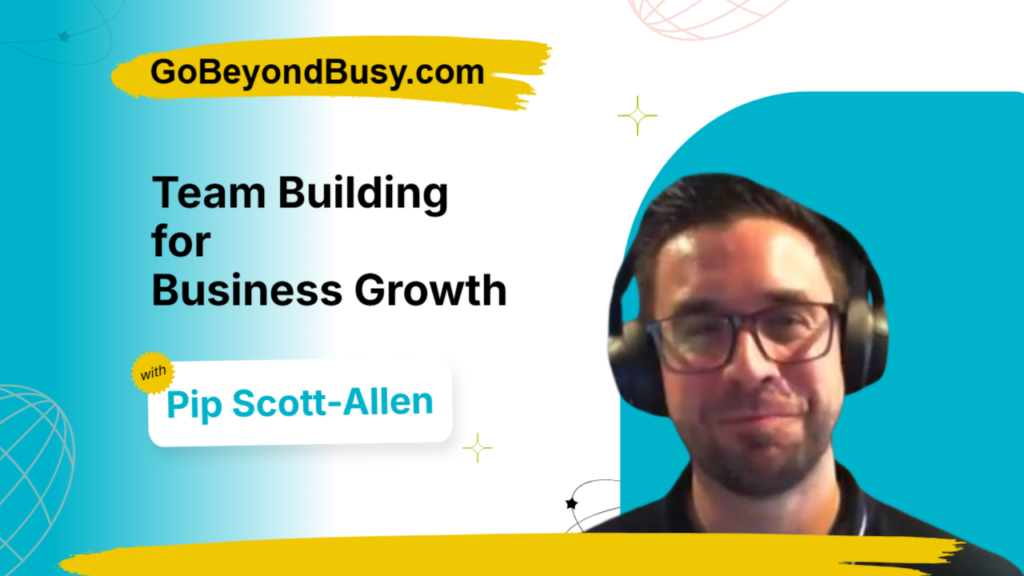
Strong teams do not happen by accident.
In this episode of Go Beyond Busy: The Small Business Growth Podcast, Christine Abela speaks with Pip Scott-Allen from Premier Team Building about what business owners often get wrong when it comes to team building.
You can contact Pip through https://PremierTeamBuilding.com.au
Pip’s answer to the opening question was simple. He wishes he had known earlier that you cannot do business alone. Knowing your craft is one thing. Building a strong business around that craft is something else entirely.
Why business owners need the right people around them
Pip explained that one of the first lessons he had to accept was the need to bring in people who were stronger than her in certain areas. For him, that included support around numbers and other parts of the business that were not his natural strengths.
That is a useful reminder for many business owners. You may be excellent at what your business sells, but that does not mean you should do every part of the business yourself.
The right support can lead to better decisions, clearer thinking, and fewer moments when you are trying to work everything out alone.
Team building is not the same as team bonding
Pip made a clear distinction between team bonding and team building.
Team bonding might be lawn bowls, fishing, or a drink at the pub. Those activities can be enjoyable and help people feel more social. However, they do not necessarily improve trust, communication, resource management, or performance.
True team building, as Pip describes it, should be fun and useful. It should connect to real outcomes such as collaboration, time management, project management, safety, trust, and better use of resources.
Leadership, culture and teams all affect each other
Premier Team Building views team development as a connected system involving leadership, culture, and teams.
Pip explained that when leadership is neglected, culture and team performance suffer. When culture is ignored, leadership and teams are affected as well.
This is where many businesses run into trouble. They may think they have a recruitment problem, when the deeper issue is culture. They may think they need more people when the real problem is that good people are leaving.
Staff retention starts with culture
One of the strongest points in the episode is Pip’s comment that it is cheaper to retain good people than to keep rehiring.
If a business owner is constantly saying, “Why can’t I find good people?” or “Why does everyone keep leaving?”, that may be a sign that the culture needs attention.
Pip described this as a “leaky bucket” problem. There is little point bringing good people into a workplace where they are unlikely to stay.
Data matters, even in people-focused work
Culture and leadership can feel like emotional topics, but Pip also talked about the value of data.
His team uses tools such as anonymous 360 reviews to understand where an organisation really is. That gives the business a benchmark, rather than relying only on opinions, assumptions, or the owner’s view of the situation.
That data can show how people feel, what they believe, where the risks lie, and how many staff may be considering leaving.
From there, the business can make better decisions and track whether things are improving.
When should a business owner talk to someone like Pip?
Pip gave several phrases that can be warning signs:
- “Why won’t they?”
- “How come they won’t?”
- “They always bring me problems.”
- “I need to hire more people.”
- “Why can’t I find good people?”
- “Why does everyone keep leaving?”
These are often signs that the business has a leadership, culture, or team issue that needs attention.
Final thought
This conversation is a useful one for any business owner who is growing a team, losing staff, or feeling frustrated that people are not taking ownership.
Pip’s message is clear. Strong teams need more than a good day out together. They need better leadership, a healthier culture, and a clear plan for improving how people work together.
Want to read the transcript?
Podcast Intro
[00:00:00] Bernard: You’re listening to Go Beyond Busy: The Small Business Growth Podcast, hosted by Christine Abela.
In this episode, Christine speaks with Pip Scott-Allen, founder of Premier Team Building, about what really drives strong teams, and why business owners cannot build a successful business on their own.
They discuss leadership, culture, and the difference between activities that feel good and strategies that actually improve performance.
Meet Pip Scott-Allen
[00:00:28] Christine Abela: Hi, I am Christine from Go Beyond Busy and I’m here with Pip Scott-Allen, who’s in the lovely Hunter Valley in New South Wales, in Australia.
How are you today, Pip?
[00:00:38] Pip Scott-Allen: I’m very well. Thank you. Yourself?
[00:00:39] Christine Abela: Very good, thank you. Apart from having a bit of a cold, so if my voice is a bit blah, that, that’s why. So tell me, Pip, what have you learned about running a business that you wish you’d known earlier?
You Can’t Do It Alone
[00:00:51] Pip Scott-Allen: That you can’t do it alone. I think I had a lot of expectations that I knew my skill very well, but running a business, you really need to be surrounded by brilliant individuals who can inspire, help you and be a sounding board. So that’s the one thing I didn’t know that I think more people should be aware. Is that you need a good community around you to have your back.
Building Your Support Network
[00:01:17] Christine Abela: So what sort of people did you need to bring on in the early days?
[00:01:22] Pip Scott-Allen: Smarter people than me. So very much recognising my weaknesses, areas that I don’t do well at, and then finding people who fill that space. And for me, that’s a lot around numbers. So I prefer getting people to support me in that space so I can do what’s best for me. They’re some of the first individuals I outsourced to or hired in that process.
[00:01:43] Christine Abela: How did you go about finding those people?
[00:01:46] Pip Scott-Allen: I had some preexisting contacts and some good friends that I trusted then was able to get involved in some different networking organisations. And through that process I was able to build some strong connections and people I trusted who I felt confident in opening up to, to say, here’s where I’m struggling, can you help? And that’s where it’s made the biggest difference for me.
From Canada to Australia
[00:02:08] Christine Abela: You don’t have an Australian accent. Tell me about that.
[00:02:12] Pip Scott-Allen: Yeah, despite living in Australia, and I’ve been here about 16 or so years at this point, I am Canadian from Northern Ontario, so Toronto and many hours north. That’s why I say funny things and sound a little bit different. I think it’s a great point of difference and it catches people’s attention. I’m sure you can understand that as well. When you’re engaging people from across the world. Now an accent helps you stand out.
What Premier Team Building Does
[00:02:34] Christine Abela: It can do. So tell me, you are running a business called Premier Team Building, but you don’t pronounce it like that, but that’s okay. So when did you set that up?
[00:02:44] Pip Scott-Allen: Definitely. So I launched Premier Team Building about six years ago, six and a half.
In reality, it’s been part of my DNA for my entire life. I’ve been in this industry since the age of 14, but so yeah, about six years ago is when I said, I’m gonna go off my own and do this.
[00:03:02] Christine Abela: So what is it? What is Premier Team Building?
[00:03:06] Pip Scott-Allen: That’s a great question. So Premier Team Building, we are a result driven team building organisation. And when we say team building, we actually look at team building as an ecosystem. So that’s leadership, culture, and teams.
So if you neglect your leadership, your culture and teams will suffer. Same thing. Ignore your culture, leadership, and teams. So it’s important that we support all three key pillars within team building.
When we say result driven, our big focus is to ensure that when we’re doing those hands-on team building programmes, which many people may recognise, that we’re providing true value and they’re actually tied to real results and measurable outcomes.
Team Bonding vs Building
We are very clear that there’s a difference between team bonding or team band-aiding and team building itself. When we look at things such as team bonding. We’re considering lawn bowls, maybe fishing, going to the pub, they’re fun, they’re social. However, chances are I probably don’t trust you any better. It’s not gonna support my resource management, my time management in any one particular area. So that’s just holding us together.
Whereas team building is gonna be fun. And that’s the big difference. It’s the and portion where it’s, and it’s going to support some measurable outcomes. Time management, collaboration, project management, trust, safety, resource management, time, all those different aspects.
So that’s what we say, result driven team building. The programmes we’re doing are fun and they’re going to deliver an outcome to our clients.
In Person or Online
[00:04:45] Christine Abela: So do you only work in person or can you work remotely?.
[00:04:49] Pip Scott-Allen: We definitely do a combination of the both. The majority of our team building programmes, when we’re having the entire organisation together, they’re typically done in person. We do have online ones. We find the majority of our clients prefer us to come in person. When we’re looking at our leadership and culture development programmes and coaching, they can be done 100% online.
It’s up to the participant as to which models suits them best. But we have found that post COVID people prefer things in person a little bit more than they do online. So although we offer it, we typically still end up in person, which is my preference.
Who They Help and When
[00:05:27] Christine Abela: So you are mainly looking at clients in New South Wales or all over Australia or all over the world?
[00:05:33] Pip Scott-Allen: All over the world. We service clients anywhere and everywhere. If they’re individuals who are looking to improve their team, their community, their culture, they’re looking to reduce staff turnover, and they really want to have a strong, healthy business, we’re looking to support them because it’s the right thing to do.
[00:05:51] Christine Abela: Okay. Sometimes, like before we did this interview and I looked at the words team building, I thought, oh, they’re a recruiting company. Do you do anything like that, or is it only once the team is there, then you help them to work together?
[00:06:05] Pip Scott-Allen: We approach it from either end of the recruitment process. So we can support recruiters by helping them support their clients by improving their culture and really getting the culture and leadership repaired.
So at times we’ll come in when there’s a leaky bucket of people leaving. Rather than employing new people into a dysfunctional, broken culture, we’ll support them in training processes to retain individuals, repair the culture. So that when the recruiters bring good people in, they’re more likely to stay, and then we continue with the relationship there afterwards to develop and grow and nurture the entire culture from that point. We don’t do recruiting, but we support recruiters to make sure that their gold stay there.
[00:06:50] Christine Abela: So what sort of size of companies do you like to work with?
[00:06:56] Pip Scott-Allen: It really does vary. I like people who care about their people, and a lot of times that doesn’t necessarily translate to size. We’ve done programmes with over 600 people at once. When we’re doing our leadership coaching programmes, we typically sit around the 12 to 20 people in the leadership team. That’s just a common size within most organisations.
Then for the team building programmes, when we get around the 50 plus, those are some really good numbers that get very creative. But we also do programmes with teams as small as four as well. So we have the flexibility and creativity to adapt to suit the individual needs of each group.
Methods and Coaching Tools
[00:07:36] Christine Abela: Do you follow any sort of methodology like EOS or Lean or any of these others?
[00:07:42] Pip Scott-Allen: We do lean into a few of those different ones. So we actually do support a number of clients who are currently going through the EOS model. So we support them with their people analyzer and we include that into our own 360 culture and leadership reviews to tick both those boxes within our team.
We’re also comprised of Disc Flex Facilitators, Belbin, Lego Serious Play, NLP, ADHD Coaches, a variety of different modalities. I like to say, we’re not party planners, we’re leadership and culture coaches. So we have the modalities and experience to back them.
Using Data to Improve Culture
[00:08:17] Christine Abela: One of the things that you might have done is to collect some sort of data on the teams that you’re working with. How does data shape teams?
[00:08:27] Pip Scott-Allen: It’s actually one of the most powerful tools we can use. When we’re looking at teams and culture, typically we follow the heart. It is a very heart driven space. We’re looking to do good for our individuals, so empathy is a driver.
However, we need to put that aside at times, put aside the ego and use data to actually recognise where we are, versus where we need to be. So when we get a lot of our clients into our ongoing programmes, be it our science leadership or the ecology of culture programmes, we start with a company-wide anonymous 360 review of those modalities. So that we can say, this is where you actually are. Ego aside, this is how your team thinks, feels and believes. Right now, this is the estimated number of people who are thinking to leave the organisation.
So now that we have a benchmark, we can make an effective plan with that data to move forward. And that allows us to check in periodically as well to see how things are progressing to ensure that everything’s moving in the right direction, or pause and adapt to where we’re seeing new different challenges.
So while it’s a very heart centric approach with what culture and leadership is, without the data, our egos and our own personal preferences can lead the way. We really do need that data to say, this is where we are, set the benchmark and let’s start this journey together.
Ongoing Programs and Redundancy
[00:09:55] Christine Abela: So the relationship between premier team building and the client is very much an ongoing relationship. You don’t just go in there for a day or a weekend or whatever and do the rah and then walk out again. You’re actually going in beforehand measuring stuff. Then you’re doing the training and then you’re going back later to see how effective that was, and then rinse and repeat. Is that how it works?
[00:10:16] Pip Scott-Allen: Relatively, yes. We do have some organisations who are still very juvenile and young in this space of culture and leadership. At times they’ll just start with an annual or biannual en mass team building programme because it’s what they believe they should do. And so for them it might be a once a year experience.
But then when we do get our clients on that ongoing process, we do join them as part of a journey. But part of that journey is to eventually leave them be or have less touch points as we go.
So when we’re doing a programme such as the ecology of culture or the science of leadership, there are 15 module programmes and ideally at the end, we could then take a step back and we’re coming in maybe quarterly at most, if not bi-annually or annually like you would going to the chiropractor or the dentist.
We need those regular, consistent checkups and management processes through those stages to ensure outcomes. Our goal isn’t to always be part of the team. One of our underlying missions is to make ourselves redundant because we teach everyone how to be great leaders and build great cultures. Our goal is to lose clients over time because they just know what the right thing to do is.
Signs You Need Help
[00:11:32] Christine Abela: If somebody’s not sure if they need you, what would be the sort of words that they might hear themselves say? Things like, my team sucks, or I really don’t know what to do with the team. What sort of things would people be saying that would be a bit of a trigger to say, oh yeah, maybe we should be talking to Pip.
[00:11:49] Pip Scott-Allen: Definitely. Some of those are definitely some great triggers or “Why won’t they?” “How come you won’t?” “They’re always bringing me problems.” A great one is, “I need to hire more people.” “Why can’t I find good people?” “Why does everyone keep leaving?” Or the other one as well is, “I’m growing, I need more people.”
And some of those examples are amazing because the growth, it’s a very positive thing, but why would they stay? We like to come in, support that culture development. So when they grow, they retain the gold. Or if they have that never ending, “I need to hire more people”, “Why can’t I find good people?”. Maybe it’s you and not them. Let’s support a culture shift so that we can retain people because it’s actually cheaper to retain than it’s to rehire by a lot.
How to Get Started
[00:12:45] Christine Abela: So how do people get in touch with you? What do they do first?
[00:12:49] Pip Scott-Allen: What we would recommend is they can find us online at PremierTeamBuilding.com au, and we do offer complimentary strategy sessions. We have a number of different tools on our website as well that are complimentary for individuals to use that will give them their own personal benchmarks where they can calculate their turnover of staff, where they can calculate what their culture currently ranks at.
But the easiest recommendation is just to book in a complimentary strategy call with one of our leadership coaches. We’ll ask you some simple questions, get a good idea of where things are at, create a picture, and then design a simple plan that you can start working on right away.
And if you don’t need our services, we’ll tell you where to go and who to get support from because we may not be the right fit. But that would be the best solution, is that complimentary strategy call.
Wrap Up and Outro
[00:13:36] Christine Abela: Great, thank you very much. I’ll put the link to your website underneath the video, and if anybody wants to have a talk with me about their business, then I’m open to that as well. So thank. Thank you very much Pip.
[00:13:47] Pip Scott-Allen: My pleasure. Thank you for your time. I appreciate greatly.
[00:13:50] Bernard: You’ve been listening to Go Beyond Busy: The Small Business Growth Podcast with Christine Abela.
For more insights, resources, and to book a free Business Strategy Session with Christine, head to GoBeyondBusy.com.

3 May 2026 · Season 3 : Season 3 · Episode 16
14 Min, 15 Sec · By Christine Abela
Team building for business growth starts with leadership and culture. Pip Scott-Allen explains how better teams reduce staff turnover and improve performance.