TL;DR: The phrase “I don’t have time” isn’t about time. It’s protective language that shields you from confronting what you’re actually choosing not to prioritise. Reframe it as “it’s not a priority” and watch how that discomfort reveals the gap between your stated goals and your daily actions. This simple language shift forces honest decisions, creates structural change in your business, and aligns your choices with what actually matters.
What This Article Covers
Why “I don’t have time” functions as a shield against difficult business decisions
The reframing exercise that exposes the gap between stated goals and actual priorities
Common autopilot tasks business owners mistake for critical work
How changing your language creates structural changes in your business
A practical test you’re doing today to audit your real priorities
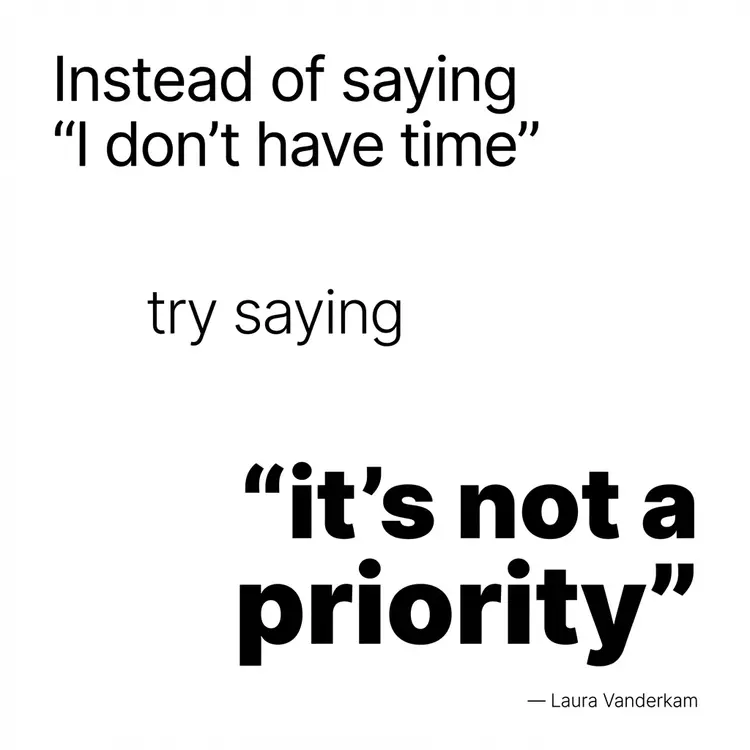
“Instead of saying ‘I don’t have time’ try saying ‘it’s not a priority,’ and see how that feels.”
— Laura Vanderkam
That quote makes most people uncomfortable. The discomfort is the point.
I’ve worked with business owners since the 2000s. I’ve heard “I don’t have time” hundreds of times. For years, I accepted it at face value. Everyone’s busy. Days are full. The to-do list never ends.
Then I met with a client who repeatedly said he didn’t have time to work on his marketing strategy. When I looked at his calendar, he had time for three-hour client meetings that should’ve been emails. Time for endless tweaking of his website footer. Time for coffee catch-ups that went nowhere.
He had time. He didn’t want to face the hard questions about who his ideal client was and whether his pricing made sense.
“I don’t have time” was a way to protect him from admitting he was afraid to make those decisions. That’s when I realised this phrase does more work than describing a busy schedule.
What “I Don’t Have Time” Really Protects You From
When you see someone filling their time with safe tasks instead of strategic work, they’re protecting themselves from being wrong. Strategic decisions have real consequences.
Pick the wrong target market, and you might lose clients. Raise your prices, and people might say no. But tweaking a website footer? That feels productive, it’s safe, and you won’t fail at it. There’s no risk of rejection or finding out that your business model doesn’t work.
Most business owners would rather stay busy with safe tasks than risk that their core approach needs to change. The scary part is admitting that the way they’ve been doing things isn’t working. That means making hard choices about what to do differently.
Key point: “I don’t have time” is a shield. It protects you from confronting whether your business model works and whether you’re willing to make difficult strategic decisions.
When the Shield Cracks: What Finally Forces Honest Priorities
Pain breaks through. Real, undeniable pain.
You’re facing payroll problems. You’re working 70-hour weeks and still not getting ahead. You’re watching a competitor do exactly what you’ve been “too busy” to do, and they’re succeeding.
I had one client who kept saying she didn’t have time to review her pricing. Then she had to take out a loan to cover her tax bill because her margins were so thin. She had time after that.
The pain made the risk of changing less scary than the risk of staying the same. The phrase stops being a shield and becomes a mirror. You see what it’s costing you.
That’s when you’re ready to have the honest conversation about priorities.
Key point: Pain forces clarity. When the cost of staying the same exceeds the fear of change, protective language stops working and honest priority conversations become possible.
The Reframing Exercise: How to Try “It’s Not a Priority”
I’m not making this about the person. I make it about the language.
Here’s what I say: “Let’s try an experiment. For the next week, every time you catch yourself saying ‘I don’t have time,’ replace it with ‘it’s not a priority’ and see how that feels.”
I frame it as curiosity, not judgment. Then I give them a specific example from their own business.
“So instead of ‘I don’t have time to review my pricing,’ try ‘Reviewing my pricing isn’t a priority right now.’ Does that feel true?”
There’s visible discomfort. They’ll pause and say something like, “Well, when you put it that way…”
That discomfort is the point. It forces them to either own the choice (“Yes, I’m choosing not to prioritise this”) or realise they need to change something.
I’m not telling them their priorities are wrong. I’m asking them to be honest about what they are. Once the language is honest, the decisions become clearer.
Key point: The reframing exercise isn’t about guilt. It’s about exposing the gap between what you say you want and what you’re choosing to do. That gap is where change starts.
What the Squirm Tells You About Your Real Goals
When someone squirms at being called “not a priority,” it reveals the gap between who they say they want to be and who they are.
A business owner will tell me: “I want to grow, I want more freedom, I want to work less.” But when they have to say out loud, “Growing my business isn’t a priority,” or “My freedom isn’t a priority,” it doesn’t match the story they’ve been telling themselves.
That discomfort is cognitive dissonance. They’re recognising that their daily choices don’t align with their stated goals.
Sometimes what’s underneath is fear. Often it’s a habit. They’ve been running on autopilot for so long that they haven’t stopped to question whether what they’re doing serves them. Or it’s guilt. They feel they “should” prioritise certain things, so admitting they’re not prioritising them feels like failure.
The squirm is them realising they’ve been lying to themselves. That’s uncomfortable. But it’s also the first step toward change, because you won’t fix a problem you won’t admit exists.
Key point: Discomfort shows misalignment. When saying “it’s not a priority” feels wrong, you’ve found the gap between your stated goals and your behaviour.
Autopilot Tasks Business Owners Mistake for Priorities
I see the same patterns in my consulting work:
Responding to every email within five minutes
Attending every networking event
Saying yes to every client request, even unprofitable ones
They’ll tell me these things are essential. “I have to be responsive.” “I need to network to get clients.” “I’m not going to say no, they’ll leave.”
But when we look at the results, that immediate email response isn’t bringing in more business. Half of those networking events lead nowhere. Clients who make difficult requests are often the least profitable. It’s busywork disguised as business-critical work.
Another big one is perfectionism around things that don’t matter. Spending hours on a proposal template or agonising over the exact wording of a social media post. They’re prioritising the feeling of being busy and looking professional over the work that moves the needle.
The autopilot part is dangerous because these tasks feel urgent and important in the moment, so they never question them. But if I ask, “What would happen if you didn’t do this?” they won’t point to a real consequence.
That’s when they realise it’s not a priority. It’s a habit they’ve never examined.
Key point: Autopilot tasks feel urgent but produce no measurable results. If stopping the task has no real consequence, it’s not a priority; it’s a habit.
How Language Change Creates Structural Business Change
The language change creates permission to say no. That’s structural.
Once a business owner says, “This networking event isn’t a priority,” they stop going. That frees up four hours. Then they use those four hours for something that matters.
Or they change how they network, for example, by joining an online BNI chapter instead of one that meets in person and requires travel.
Finally, sorting out their pricing. Building that email sequence they’ve been avoiding.
They’re making decisions based on what moves their business forward, not what feels urgent or what they think they “should” do.
I’ve seen it change hiring decisions as well. One client realised she was spending hours on administrative tasks because she said, “I don’t have time to train someone.” When she reframed it as “Training someone isn’t a priority,” she heard how ridiculous that sounded. She was choosing to stay stuck.
Within a month, she’d hired a VA and freed herself up to do strategic work.
The business begins to reflect its real priorities rather than its fears or habits. Decisions become easier with clarity. The team picks up on it as well. If the owner is clear about priorities, everyone else knows what matters.
The whole culture shifts from reactive and chaotic to intentional and focused.
Key point: Honest priority language gives you permission to say no, which frees up time for strategic work. This creates a cascade of better decisions and a clearer business structure.
The Cascade: One Priority Decision Leads to Another
The language change forces decision-making at every level. Once a business owner says “it’s not a priority” out loud, they won’t hide. Not from themselves, not from their team.
I had a client who realised she was spending hours each week on non-priority admin tasks. So she hired a part-timer. That one decision freed up time for strategic work, which led to a pricing review, which increased her margins, and ultimately made her more selective about clients.
One decision cascades into the next.
The language also changes how they communicate with their team. Instead of “I don’t have time to train you properly,” it becomes “Training isn’t a priority right now.” That sounds ridiculous when you’ve hired someone.
So training becomes a priority. Or they stop hiring until they’re ready to make it one. Either way, it’s a clear decision instead of a vague excuse.
The business reflects actual priorities rather than reactive chaos. Clients notice too. When you’re clear about your priorities, you stop overcommitting and underdelivering. You say no to things that don’t fit, and the work you do say yes to gets done properly.
The whole structure tightens up because there’s honesty running through it, rather than protective language holding everything together.
Key point: One honest priority decision creates a cascade. It frees up time, enabling strategic thinking, which leads to better margins, and gives you the freedom to choose better clients.
A Test Worth Trying Today
The next time “I don’t have time” comes out, replace it with “it’s not a priority” and see how that feels. Even if you only do it quietly, in your own head.
The goal isn’t guilt. The goal is honesty.
Some things aren’t priorities, and that’s fine. The problem arises when the things that would reduce stress, increase profit, or create long-term stability are permanently treated as optional.
Time is fixed. Priorities are chosen. When you change the language, you force yourself to confront what you’re choosing.
Businesses reflect the priorities of their owners. Changing the language is often the first step in changing the business. That small shift is more worthwhile than finding an extra hour in the week.
Common Questions About Priority Language
What if something genuinely isn’t a priority right now but needs to be later?
Then say that. “This isn’t a priority right now, but it will be in Q3.” The point is to be honest about your timeline and stop using “no time” as a blanket excuse. If something matters, schedule it when it becomes a priority.
How do I know if I’m being too hard on myself with this reframing?
If saying “it’s not a priority” feels true and you’re comfortable with that choice, you’re not being too hard on yourself. You’re being honest. The discomfort only comes when there’s misalignment between what you say you want and what you’re doing.
What if I reframe it and realise everything is a priority?
Then you don’t have priorities, you have a list. Priorities require ranking. If everything is a priority, nothing is. Start by asking: “If I stopped doing this tomorrow, what’s the real consequence in 30 days?” That’ll show you what’s a priority.
How do I use this language with my team without sounding harsh?
Frame it as clarity, not criticism. “Right now, our priority is X, so Y isn’t a focus until we finish X.” Your team wants clarity more than they want to be busy. Honest priority language helps them focus.
What if my priorities keep changing week to week?
That’s a strategy problem, not a language problem. If your priorities shift constantly, you’re reacting instead of planning. Use this language to audit what’s driving those changes. Are they real shifts, or are you avoiding the hard work?
Does this work for personal priorities as well, or only for business?
Works everywhere. Try saying “Exercise isn’t a priority” or “Spending time with my kids isn’t a priority” and see how that feels. The discomfort is the same. The gap between stated values and actual choices shows up in every area of life.
What’s the difference between something not being a priority and procrastinating?
Procrastination occurs when something is a priority, and you avoid it. Not being a priority is a conscious choice. If you’re procrastinating, you’ll feel guilty and stressed. If something isn’t a priority, you’ll feel fine about not doing it.
How long does it take for this language shift to change behaviour?
The awareness is immediate. The behaviour change depends on how uncomfortable the gap is. If saying “growing my business isn’t a priority” feels wrong, you’ll start changing within days. If it feels true, you’re already aligned.
Key Takeaways
“I don’t have time” is a protective statement that shields you from confronting your actual priorities and difficult strategic decisions.
Reframing “I don’t have time” as “it’s not a priority” creates immediate discomfort, revealing the gap between your stated goals and your daily actions.
Pain (financial pressure, burnout, watching competitors succeed) is what finally breaks through the protective shield and forces honest priority conversations.
Most business owners run on autopilot, filling time with safe busywork (instant email replies, endless networking, perfectionism) that feels urgent but produces no measurable results.
Honest priority language creates structural change: it gives you permission to say no, which frees up time for strategic work, which cascades into better margins and clearer decisions.
Your business reflects your actual priorities, not your stated ones. Changing the language forces you to align your choices with what you say you want.